2027 Rivian R2 Performance vs. 2026 Jeep Recon Moab: EV Comparison Test
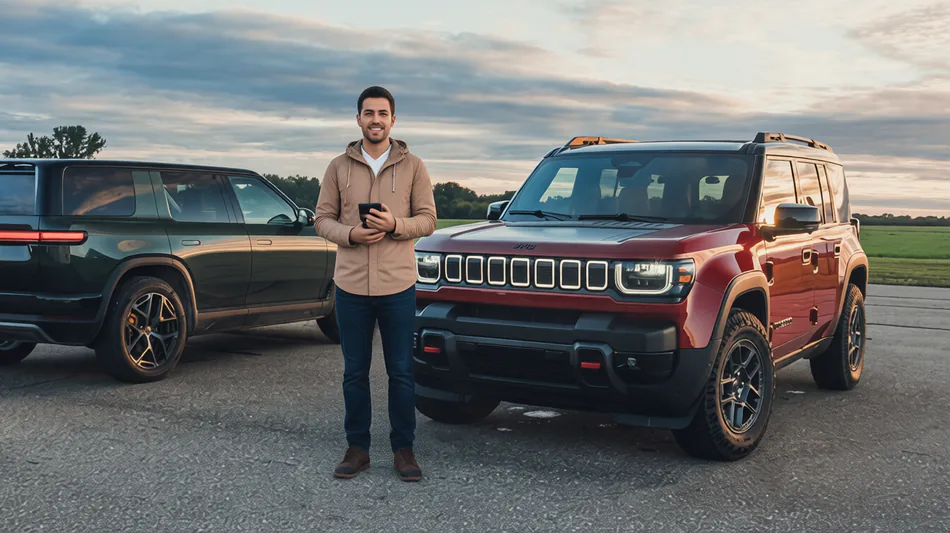
In a head-to-head evaluation of two squared-off electric SUVs, the 2027 Rivian R2 Performance and the 2026 Jeep Recon Moab present conflicting strengths. While the Jeep offers rugged, Wrangler-inspired styling and removable components, the Rivian delivers superior efficiency, range, and driving dynamics at a lower price, ultimately securing the win in this comprehensive comparison.
The traditional hierarchy between automotive incumbents and challengers is difficult to apply to the current battle between the 2027 Rivian R2 Performance and the 2026 Jeep Recon Moab. Jeep, a manufacturer with a lineage of SUV production dating back to the 1940s, is relatively inexperienced in the electric vehicle (EV) sector. Conversely, Rivian entered the market only five years ago, yet its entire portfolio consists exclusively of EVs, and the R2 represents its third model. The question of which brand’s position confers a greater advantage becomes central to this comparison.
The 2027 Rivian R2 Performance tested here arrives with the Launch package, a strategy typical for new EV launches that prioritizes higher-margin trims initially. This configuration includes a 4,400-pound towing capacity and hands-free driving assist features. While simpler variants are expected to approach the $50,000 price point, this specific tester, finished in Launch Green paint, carried a total price of $61,485. Standard equipment includes a power roll-down rear hatch glass, a feature Rivian emphasizes for lifestyle appeal, allowing for ventilation without exhaust fumes.
The 2026 Jeep Recon is currently available exclusively in the Moab trim, a designation Jeep uses to indicate elevated off-road capability and a corresponding premium price. The Recon’s base sticker of $68,990 exceeds the as-tested price of the Rivian. With added options, including a $1,995 Comfort package featuring ventilated front and heated rear seats, and a $995 towing package with a 3,300-pound capacity, the tested Recon reached $73,345. Standard off-road hardware includes skid plates, an electronically locking rear differential, and 33-inch all-terrain tires. Emphasizing its connection to the Wrangler lineage, the Recon features doors and rear windows that are removable without tools, though their weight of approximately 70 pounds each presents a physical challenge.
Stylistically, the R2 adopts a cleaner, more modern aesthetic described as a scaled-down version of the larger R1 model. It utilizes Rivian’s signature ovoid headlights and avoids divisive design elements in favor of broad market appeal. The tested vehicle featured 21-inch wheels with all-season tires, though tougher 20-inch wheels with all-terrain tires are available at the cost of EPA-rated range, which drops from 330 miles to 307 miles.
The Recon’s design is intentionally rugged and anti-aerodynamic, featuring a square profile, tall stance, and a front bumper resembling a bulldog’s underbite. This results in a drag coefficient of 0.404. The vehicle maintains the Wrangler’s removable door and window concept, allowing it to transform from a closed SUV into an open-air vehicle with a full-length canvas roof.
Interior layouts reflect the distinct design philosophies of their manufacturers. The Rivian interior is sparse and screen-centric, minimizing physical controls in favor of touchscreen interfaces and scroll wheels for functions such as steering wheel and mirror adjustments. This approach requires navigating menus to perform tasks that are typically immediate, a process Rivian refers to using "haptic halo wheels." The cabin features birch trim spanning the dashboard.
The Jeep Recon offers a more conventional interior with hard buttons on the dash and steering wheel, alongside physical knobs for volume and tuning. It supports wireless Apple CarPlay and Android Auto, whereas the Rivian does not offer phone mirroring. Both vehicles provide sky views; the R2 uses a fixed panoramic glass roof, while the Recon offers a power roll-back soft top. The Recon allows for the removal and storage of its rear windows in bags, reinforcing its commitment to open-air travel.
Performance metrics for both vehicles align with current EV standards, offering acceleration figures that surpass many traditional sports cars. The Rivian R2’s dual motors produce 656 horsepower and 609 pound-feet of torque, enabling a 0-60 mph time of 3.5 seconds and a quarter-mile time of 11.4 seconds at 126 mph.
The Jeep Recon is slightly more powerful, with 670 horsepower and 620 pound-feet of torque driving its large Nexen Roadian ATX tires. It matches the R2 in 0-60 mph acceleration but trails in the quarter-mile, recording 11.8 seconds. The Recon’s speed is limited to 111 mph, a cap it reaches before completing the quarter-mile distance.
Range efficiency favors the Rivian significantly. Despite having a smaller 88-kWh battery compared to the Jeep’s 94-kWh pack, the R2 achieves superior efficiency. In testing at 75 mph, the R2 traveled 260 miles, outlasting the Recon by 100 miles. The Rivian also charged faster, reaching 90 percent state of charge in 39 minutes compared to the Jeep’s 43 minutes. The Recon’s EPA-estimated range is 222 miles, falling short of the 300-mile threshold common among modern EV expectations.
Handling dynamics reveal differences in engineering priorities. On a skidpad, the Rivian achieved 0.81 g of grip, while the Jeep managed 0.74 g. Braking performance also favored the R2, stopping from 70 mph in 178 feet versus the Recon’s 201 feet. Both vehicles exhibit handling characteristics similar to traditional muscle cars, prioritizing straight-line speed over cornering agility.
The Recon demonstrates improved on-road competence compared to its internal-combustion Wrangler counterpart, aided by an independent front suspension and rack-and-pinion steering. The ride is cushioned by the 70-profile aspect ratio of the all-terrain tires, which also protect against potholes and trail obstacles.
The Rivian R2’s suspension, utilizing conventional anti-roll bars, provides firm body control with sufficient compliance to absorb pavement imperfections without abruptness. Brake regeneration in both vehicles is mandatory upon lifting off the accelerator. The Recon’s regen is milder, feeling more like coasting, while the Rivian strongly encourages one-pedal driving, even in its weakest mode.
Off-road capability was not fully tested, but specifications suggest competitiveness. The Jeep offers 9.1 inches of ground clearance and 33-inch tires. The Rivian R2 provides slightly more ground clearance at 9.6 inches and 32-inch tires, indicating both vehicles would be capable in muddy conditions.
The final verdict favors the Rivian R2 Performance. It delivers the design language and performance characteristics of the larger, more expensive R1S at a significantly lower price point. The R2’s combination of over 300 miles of EPA-rated range, rapid acceleration, and efficient charging makes it a compelling electric family SUV. The Jeep Recon, while charismatic and capable of Wrangler-like experiences, is hindered by its high price and limited range, positioning it more as an EV beachhead for the brand than a primary volume contender.
2026 Jeep Recon Moab Specifications: Vehicle Type: Front- and rear-motor, all-wheel-drive, 5-passenger, 4-door wagon Price: Base $68,990 / As Tested $73,345 Options: Comfort package ($1,995), trailer-tow package ($995), black roof ($995), all-weather cargo mat ($200), all-weather floor mats ($170) Powertrain: Front and rear permanent-magnet synchronous AC motors, 335 hp and 310 lb-ft each. Combined 670 hp, 620 lb-ft. Battery: 94-kWh liquid-cooled lithium-ion Charge Rate: 11.0 kW AC / 203 kW DC Chassis: Control arms/multilink suspension, 13.8-inch vented disc brakes front and rear Tires: Nexen Roadian ATX 265/70R-18 Dimensions: Wheelbase 112.9 in, Length 193.3 in, Width 76.2 in, Height 73.8 in Weight: 6,190 lb Test Results: 0-60 mph 3.5 sec, 1/4-mile 11.8 sec @ 111 mph, 70-0 mph braking 201 ft, Skidpad 0.74 g Fuel Economy: Observed 59 MPGe, 75-mph Highway Range 160 mi, EPA Combined/City/Highway 71/80/62 MPGe, Range 222 mi
2027 Rivian R2 Performance AWD Launch Edition Specifications: Vehicle Type: Front- and rear-motor, all-wheel-drive, 5-passenger, 4-door wagon Price: Base $59,485 / As Tested $61,485 Options: Launch Green paint ($2,000) Powertrain: Front permanent-magnet synchronous AC motor (294 hp, 254 lb-ft), Rear motor (362 hp, 355 lb-ft). Combined 656 hp, 609 lb-ft. Battery: 88-kWh liquid-cooled lithium-ion Charge Rate: 11.0 kW AC / 230 kW DC Chassis: Struts/multilink suspension, 13.8-inch vented disc front brakes, 13.2-inch vented disc rear brakes Tires: Pirelli Scorpion MS Elect 255/55R-21 Dimensions: Wheelbase 115.6 in, Length 185.9 in, Width 75.0 in, Height 66.9 in Weight: 4,985 lb Test Results: 0-60 mph 3.5 sec, 1/4-mile 11.4 sec @ 126 mph, 70-0 mph braking 178 ft, Skidpad 0.81 g Fuel Economy: Observed 82 MPGe, 75-mph Highway Range 260 mi, EPA Combined/City/Highway 105/114/96 MPGe, Range 330 mi
Z.Bianchi--IM