US, Iran truce hangs in balance as war flares in Lebanon / Photo: - - AFP
The fragile two-week truce between Iran and the United States was hanging in the balance on Wednesday, with Tehran threatening to resume hostilities as Israel launched a major bombardment of Lebanon.
Washington and Tehran both claimed victory after agreeing to a two-week ceasefire and negotiations aimed at ending a war that has killed thousands across the Middle East and sparked global economic upheaval.
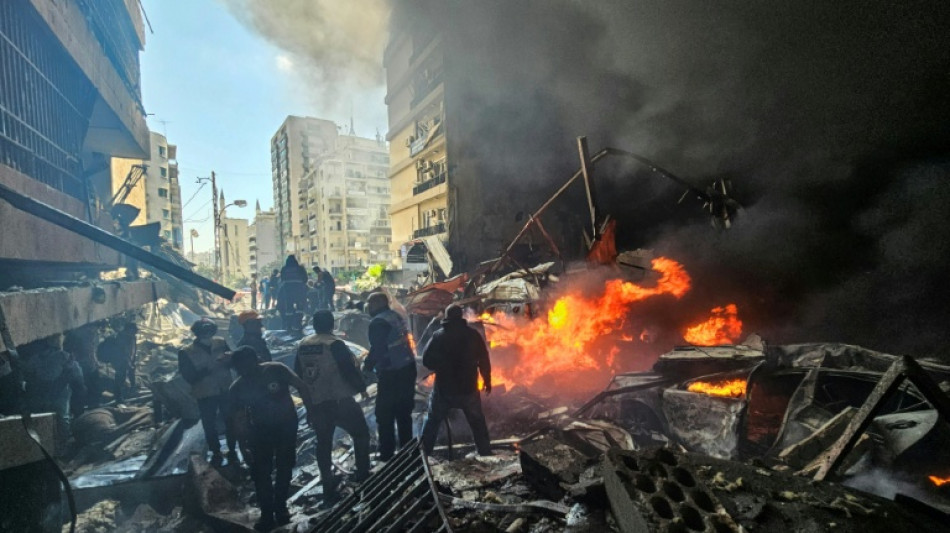
But the deal's fractures have emerged as Israel carried out its heaviest strikes on Lebanon since Iran-backed militant group Hezbollah joined the war in early March, killing 112 people and wounding hundreds on Wednesday, authorities said.
Israel said its battle against Hezbollah in Lebanon is not part of the US-Iran truce agreed late Tuesday, but Iran's parliament speaker appeared to threaten the ceasefire over what he called "repeated violations" of Iran's framework for talks.
"The very 'workable basis on which to negotiate' has been openly and clearly violated, even before the negotiations began. In such a situation, a bilateral ceasefire or negotiations is unreasonable," Mohammad Bagher Ghalibaf posted on X.
Adding to the fragility of the truce agreed hours before a deadline set by US President Donald Trump, a senior US official said Iran's 10-point plan was not the same set of conditions agreed by the White House to pause the war.
In Lebanon, where the UN rights chief Volker Turk called the scale of killing "horrific", strikes across capital Beirut without warning triggered scenes of horror and panic.
"People started running left and right, and smoke was billowing," said Ali Younes, who was waiting for his wife near Corniche al-Mazraa, one of the areas targeted.
More than 1,500 people have been killed in Lebanon since Israel launched airstrikes and a ground invasion in early March, local officials said.
Iran's Revolutionary Guards warned they would "fulfil our duty and deliver a response" if Israel did not cease its strikes there, while Hezbollah said it had a "right" to respond despite appearing to have halted its attacks after the truce.
For Israel's part, Prime Minister Benjamin Netanyahu said the country remains prepared to confront Iran if necessary as it still had "objectives to complete", with the military saying it continued to pursue the goal of "disarming" Hezbollah in Lebanon.
Pentagon chief Pete Hegseth has also vowed that American forces remain at the ready if the conflict flares up again.
- High-stakes talks -
The belligerent rhetoric came ahead of high-stakes talks in Pakistan expected on Friday after Iran temporarily agreed to reopen the Strait of Hormuz under threat of annihilation by Trump, with ships passing through the strategic waterway on Wednesday.
But reports suggested the strategic waterway was shut later in the day despite the ceasefire, leading the White House to call on Iran to reopen it "immediately, quickly and safely".
Any closure "is completely unacceptable," White House Press Secretary Karoline Leavitt told reporters.
Pakistani Prime Minister Shehbaz Sharif, whose country mediated the ceasefire, said Wednesday that violations between the United States and Iran "have been reported" and pressed countries to respect the truce.
"I earnestly and sincerely urge all parties to exercise restraint and respect the ceasefire for two weeks, as agreed upon, so that diplomacy can take a lead role towards peaceful settlement of the conflict," Sharif said on X.
Iranian state media reported that Foreign Minister Abbas Araghchi, in a call with the commander of Pakistan's armed forces, had accused Israel of "violations of the ceasefire in Iran and Lebanon".
Further underscoring the precarity of the truce, Iranian state media announced fresh "missile and drone attacks" Wednesday on US-allied Gulf states the UAE and Kuwait in retaliation for airstrikes against its oil facilities.
Kuwait said its oil facilities and power and desalination plants were damaged in "an intense wave" of strikes that lasted hours.
The UAE said it was targeted with 17 Iranian missiles and 35 drones since the ceasefire took effect, Saudi Arabia intercepted nine drones and Bahrain said its capital Manama came under attack.
- 'Real hope' -
On Wednesday, the leaders of several European nations, Canada and the UK said "a swift and lasting end to the war" must be negotiated as Pope Leo hailed a moment of "real hope".
But Tehran's demands over uranium enrichment, economic sanctions and future control over the Strait of Hormuz -- a narrow waterway through which one-fifth of the world's oil passes -- are deeply at odds with the United States.
The United States and Israel said they attacked Iran to degrade its military capacity.
After weeks of economic turmoil, the ceasefire announcement sent oil prices plunging more than 17 percent, while European natural gas dropped 20 percent.
Trump said the United States was "very far along" in negotiating a long-term agreement with Iran, which had submitted the 10-point plan that he said was "workable".
But Ghalibaf listed three alleged US violations of the proposal: the continued attacks in Lebanon, a drone entering Iranian airspace and a denial of the country's right to enrichment, leaving the longevity of the truce uncertain.
In Tehran, streets were quieter than usual on Wednesday, with many shops closed after a long and anxious night for city inhabitants fearing a massive US attack.
"Everyone is at ease now," Sakineh Mohammadi, a 50-year-old housewife, told AFP, saying she was "proud" of her country.
"We are more relaxed."
burs/jfx/arp
A.Goretti--IM