EU helps cities tighten screws on Airbnb, holiday rentals / Photo: JAIME REINA - AFP/File
European cities will gain more leeway to curb short-term rentals such as Airbnb under plans aimed at bringing down housing costs in tourism hotspots put forward by the EU Wednesday.
The European Commission laid out conditions under which local authorities can limit short lets, as part of an "affordable housing" package seeking to address what commission vice-president Teresa Ribera called a "terrible crisis".
"When the market fails to deliver something as fundamental as an affordable home, public authorities have a responsibility to act," Ribera said as she presented the measures.
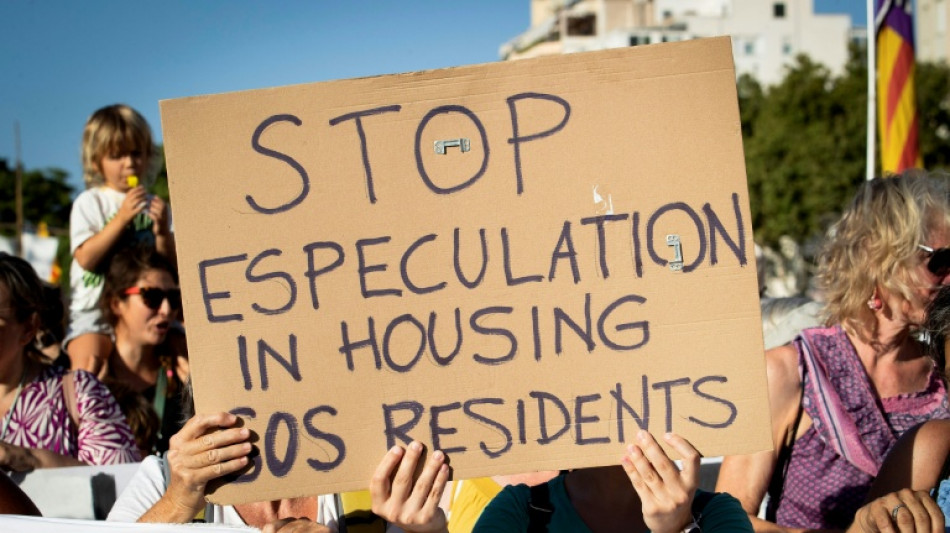
Though hugely popular with visitors, short-term lodgings are blamed by residents in many popular travel destinations for depriving locals of apartments for long-term rent and pushing up prices.
From New York to Tokyo and Barcelona, a growing number of cities worldwide have imposed or considered restrictions on tourist flats in recent years.
But curbs have often been followed by court challenges from rental providers and tourism operators, resulting in legal uncertainty.
The commission's Affordable Housing Act -- which still has to be negotiated with lawmakers and EU countries -- aims to provide cities with legal cover, clarifying when authorities can take action without falling foul of EU single market rules.
Cities and other relevant authorities will be allowed to limit holiday rentals as well as the purchase of property for short-term letting purposes in areas deemed "under housing stress".
The law lays out a series of parameters that need to be met for an area to be defined as under stress, such as the ratio between house prices and incomes there.
Before introducing restrictions, authorities must demonstrate that short-term rentals have had a significant adverse effect on housing affordability or availability for at least three years.
Population and housing supply and demand trends will also need to be taken into account and any measure will have to be non-discriminatory, proportionate and limited in duration to a maximum of five years, according to the proposal.
- 'Structural solutions' -
The legislation will not affect landlords who rent out their own primary residence for short periods of time -- nor rules cities brought in before it is adopted.
Housing affordability has become a growing issue across the 27-nation bloc in recent years, with 51 percent of European city dwellers telling a 2025 survey it was "an immediate and urgent problem".
Property prices have surged by 60 percent, while rents have climbed by 20 percent over the past decade, leaving millions struggling to find a home they can afford, according to Brussels.
The EU says this is mainly driven by insufficient housing supply, but short-term lets add extra pressure in certain areas.
"Short-term rental activity" grew 93 percent across four major letting platforms between 2018 and 2024, according to the EU.
While such lets account for only about 1.2 percent of the European Union's housing stock, according to EU data, the share can be much higher in popular districts of some tourist destinations.
In central Madrid for example there are around 40 short-term rentals for every 100 homes in the long-term rental market, Brussels said.
Yet rental providers dispute that holiday lets are to blame for rising house prices.
"For the great majority of cities, the claim that short-term rentals are driving housing stress does not survive contact with this evidence," tech lobby group CCIA wrote in a letter to the commission this month.
In some cities with restrictions, rents and hotel prices have gone up, the letter added, noting that Lisbon recently overturned some of the curbs it had previously imposed.
"Europe's housing crisis needs structural solutions, and the implementation of this act should focus on increasing the supply of homes," said an Airbnb spokesperson.
D.Lombardi--IM