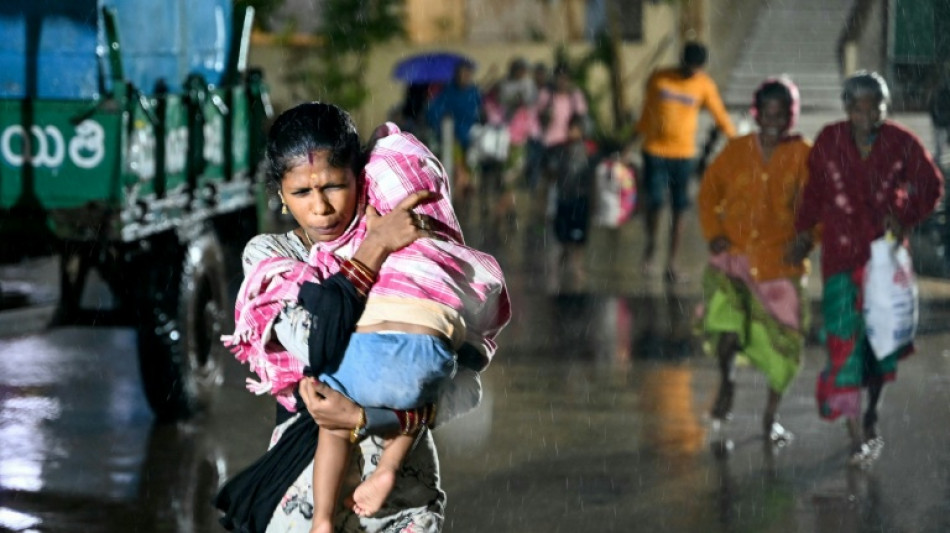
Cyclone eases after lashing India coast, no deaths reported / Photo: Noah SEELAM - AFP
Ferocious winds and torrential rain lashed India's southeastern coast after a cyclone made landfall on Wednesday, but officials said there were no initial reports of deaths and the storm later began to ease.
Cyclone Arnab hit southeastern Andhra Pradesh state as a "very severe cyclonic storm", with winds of 125-135 kilometres (77-84 miles) per hour and gusts reaching 150 kph in the early hours of Wednesday morning, the India Meteorological Department (IMD) said.
Torrential rain was recorded -- as much as 30 centimetres (nearly 12 inches) in parts of Andhra Pradesh and Odisha states, IMD said, with the storm due to weaken into a "deep depression" throughout Wednesday afternoon.
Andhra Pradesh Chief Minister Nara Chandrababu Naidu said there had been no reported deaths from the storm, congratulating government officers who had "worked tirelessly throughout the night".
Naidu "expressed satisfaction that no loss of life occurred due to the proactive measures taken", his office said in a statement.
"We are making every possible effort to minimise the impact of the cyclone... and restore normalcy at the earliest," Naidu added.
Around 50,000 people were told to move to safer areas in Andhra Pradesh and another 48,000 in neighbouring Odisha.
"Our homes get flooded, and we have to stay in the water," said Rajeshwari, 65, who gave only one name and had been taken to a government-run shelter near Kakinada.
Overnight, gales battered trees and heavy rain lashed the port city of Kakinada, close to the heart of the storm, as powerful waves crashed ashore.
Residents on Wednesday emerged onto flooded streets to what appeared to be limited damage in the city.
- 'Safe indoors' -
Emergency officials were also busy clearing uprooted trees and other debris from affected roads in the coastal region.
"Thank God, there was not as much damage this time," said businessman Hussain, 43, who uses one name.
"The sea is very rough, several trees have fallen, and sheds and hoardings have been damaged."
Sadiq, 40, a Kakinanda city resident, told AFP that the situation had become "very dangerous" on Tuesday night, but early warnings from authorities had helped people prepare.
"Many people locked their houses and moved to safer places", he said.
Cyclones, called hurricanes in the North Atlantic and typhoons in the Pacific, are a regular menace in the Bay of Bengal and northern Indian Ocean.
The storm season, however, has been turbocharged by the El Nino weather phenomenon that has contributed to unprecedented warming.
Neighbouring Sri Lanka and Nepal had also issued warnings.
Nepal's disaster authority warned that the storm would move inland towards the Himalayas, bringing heavy rainfall and "a high risk of heavy snowfall, snowstorms and avalanches".
Nepal is still recovering from a catastrophic August 26 flood triggered by a glacial mountain collapse, which killed more than 1,400 people and left over 5,000 missing.
I.Pesaro--IM