Hope for peace with North, but not unification at S. Korea festival / Photo: Jung Yeon-je - AFP
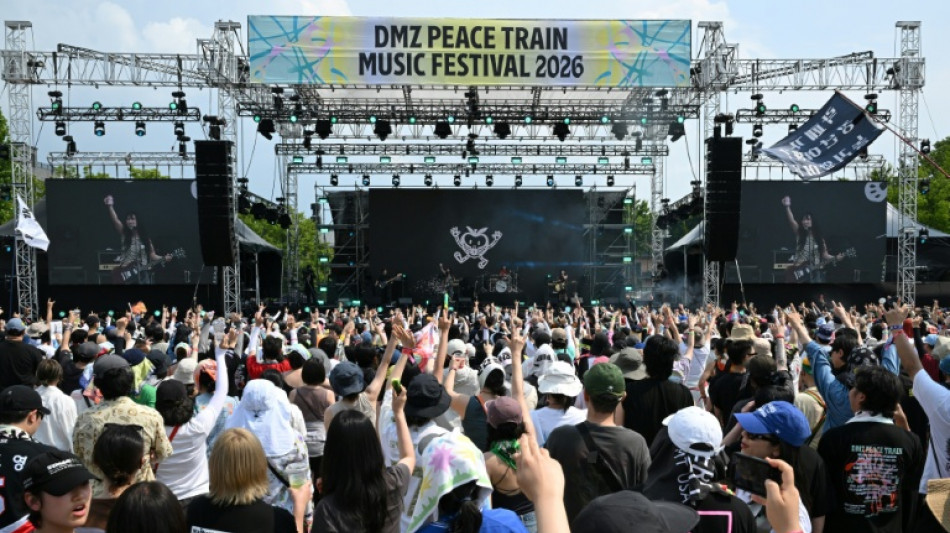
A stone's throw from the barbed wire and minefields that separate the two Koreas, thousands gathered for a music festival this weekend to sing about peace in a place synonymous with conflict.
The DMZ Peace Train Music Festival, named after the demilitarised zone that has separated the neighbours for seven decades, gathered artists and fans from around the world.
It was the seventh instalment since the inaugural festival was held in 2018 under the slogan: "Let's dance for a world without borders!"
But it came at a time South Koreans, especially younger ones, seem to be giving up on the possibility of reunification.
"It may be difficult to become one country... but I hope we can at least move forward by letting go of that tense atmosphere and building more peaceful exchanges between each other," said Jo Seong-bin, a 20-year-old student who came to celebrate the end of his mid-year exams.
It is a pragmatism shared by members of South Korean indie rock quartet Peach Truck Hijackers.
They arrived Friday, two days before their set, at the festival grounds in the rural county of Cheorwon, some 50 kilometres (31 miles) north of Seoul and bordering on the DMZ.
"The number one thing is to not make the situation any worse," Lee Chung-Kyoung, the band's singer and guitarist, told AFP.
"It does seem really difficult to imagine a world where it gets better or where we unite again but I hope that happens."
Such sentiments reflect a trend among South Korean youth.
According to a survey conducted at the end of May 2026 by the National Unification Advisory Council (NUAC) -- a body that advises the president -- nearly half (49.8 percent) of 1,200 respondents aged 19 to 39 view North Korea as "hostile".
Fewer than a third regarded the North as a potential partner, and just over one in ten support actively pursuing reunification.
The most heavily militarised border in the world is the one drawn between North and South Korea in 1953.
Bristling with razor wire, sensors, landmines and heavy weapons, the DMZ stretches for 250 kilometres (155 miles).
Seoul and Pyongyang technically remain at war, as the 1953 armistice that halted fighting was never followed by a peace treaty.
- 'A different perspective' -
The festival brought together an eclectic mix of artists ranging from the jazz-funk of Indonesia's Batavia Collective and British post-punk group Deadletter, to ex-Sonic Youth member Thurston Moore from the United States and French group La Flemme.
The event also attracted an international audience.
New Yorker Francesca, who did not want to give her surname, said the event allows for "different perspective... from what we learn about Korean politics."
The 25-year-old social worker and a friend visited an interactive booth offering a deep dive into the DMZ archives -- a space created in collaboration with South Korea's Ministry of Unification.
Ministry official Park Sung-ryeol told AFP events such as the festival helped raise awareness of South Korea's pursuit for "peaceful coexistence, a yearning for peace."
But such hopes appear increasingly vain with Pyongyang remaining unreceptive to the overtures of South Korea's centre-left president, Lee Jae Myung.
Lee has tried, in vain, to improve relations that became abysmal under his conservative predecessor, Yoon Suk Yeol.
In a reminder that hope springs eternal: performing arts promoter Martin Elbourne, who founded the festival, points to the fall of the Berlin Wall in 1989.
"When I was a child, I used to spend my summer holidays in East Germany and I didn’t expect things to change, he told AFP by email from Redhill, south of London.
E.Colombo--IM