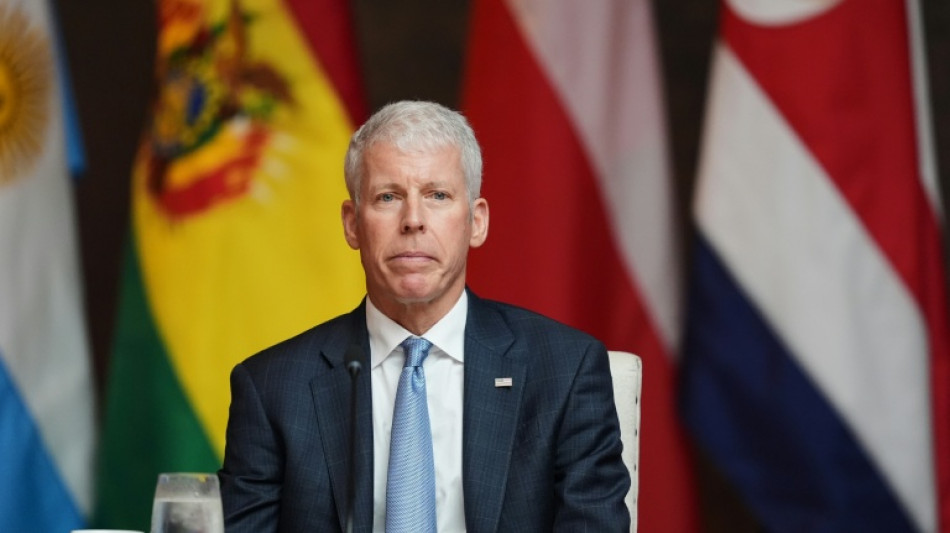
White House says US Navy has not escorted tanker through Strait of Hormuz / Photo: Rebecca Blackwell - POOL/AFP/File
The United States has not escorted any oil tanker through the Strait of Hormuz, the White House said Tuesday, after the energy secretary's social media account posted and deleted a claim that it did so.
The shift in narrative caused markets to swing, with oil dropping sharply after Energy Secretary Chris Wright's initial post.
Oil prices pared back some losses after Wright's post on X was deleted -- just minutes after publication.
"I can confirm that the US Navy has not escorted a tanker or a vessel at this time, though of course that's an option," White House Press Secretary Karoline Leavitt told a briefing.
Iran's Revolutionary Guards also said that no US Navy vessel has "dared" approach the Strait of Hormuz, calling Wright's claim a "pure falsehood."
The US Energy Department and Pentagon did not immediately respond to AFP requests for comment.
At least 10 oil tankers in or near the Strait of Hormuz were struck, targeted or reported attacks between March 1 and 10, according to data compiled by the UK Maritime Trade Organisation (UKMTO), the International Maritime Organization (IMO), and Iranian authorities.
No US ships were confirmed to have escorted oil tankers in the key waterway since the war was launched on February 28. Wright's initial comments marked the first time a US official said this had occurred.
In his deleted post, Wright said the "US Navy successfully escorted an oil tanker through the Strait of Hormuz to ensure oil remains flowing to global markets."
Nearly a fifth of global oil production passes through the strait, with Tehran on Tuesday vowing that none would be exported from the Gulf while the war is ongoing.
Since March 2, more than 20 commercial vessels have been detected crossing the strait, according to AFP analysis of data from shipping tracker Marine Traffic.
Others have passed through with their transponders switched off to conceal their position, sometimes only reappearing on marine trackers once safely out of the area.
Before the war, a daily average of 138 ships transited the Strait of Hormuz.
President Donald Trump's administration has taken steps to try and reassure global markets since launching the war, offering reinsurance to shipping companies and the US Navy's services to escort tankers.
Crude prices have fluctuated sharply due to supply disruptions, jumping 30 percent on Monday to nearly $120 per barrel before retreating.
They continued to fall after comments by Trump on Monday hinting that the war may end soon, even as his defense secretary vowed a day later to carry out the "most intense day of strikes inside Iran."
The war has seen strikes carried out on oil depots in Iran and attacks on energy infrastructure in wealthy Gulf countries, previously seen as safe havens in a turbulent Middle East.
Z.Bianchi--IM