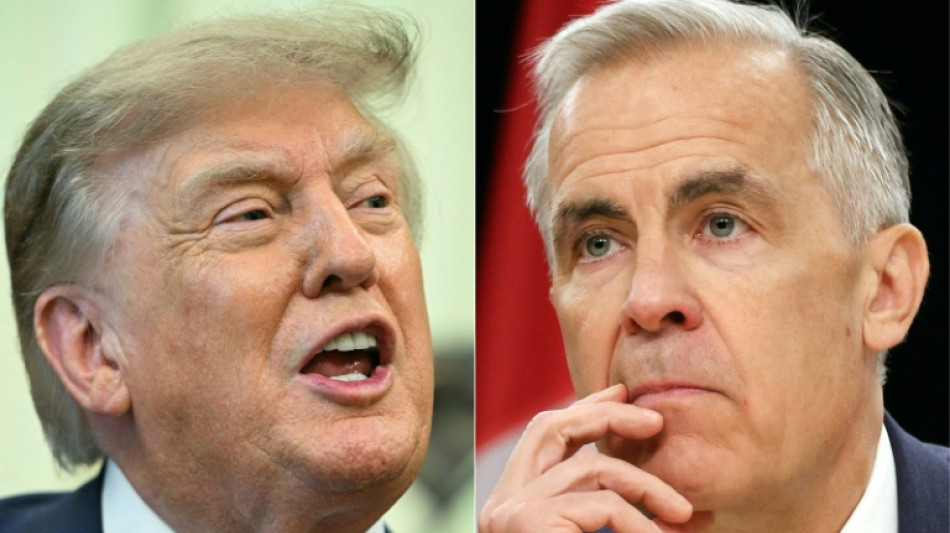
Canada unveils counter-tariffs of 15-50% on US goods / Photo: Jim WATSON, Dave Chan - AFP/File
Canada on Tuesday announced counter-tariffs on US goods ranging between 15 and 50 percent, intensifying the trade war between the historically close allies.
Ottawa's retaliation will take effect September 8, a timeframe earlier outlined by Prime Minister Mark Carney after US President Donald Trump's 50-percent duties came into place Saturday.
Canadian officials said Tuesday that the retaliatory tariffs will match US levels, with impacts on industries including steel, dairy and electronics.
Canada's government also announced a $5.4 billion (CA$7.5 billion) aid package for impacted firms and workers.
"This is an unprecedented challenge imposed on Canada. But Canada will meet the moment," Finance Minister Francois-Philippe Champagne said.
"I think what Canadians can see this morning is that we stand united," he added. "Canada must respond and today we are, in a proportionate, targeted and strategic way."
Industry Minister Melanie Joly echoed Champagne's call for Canadians to support local businesses, while vowing to work with new allies and trading partners.
"We cannot wait for Washington to decide our future," she said.
- Tit-for-tat? -
The steep US tariffs hit about $20 billion in Canadian goods -- about 5.5 percent of its exports to the United States -- after trade negotiations collapsed at the eleventh hour.
Under Canada's planned response, US steel and aluminum products previously subject to a 25-percent duty will soon face 50-percent tariffs.
Goods facing 25-percent tariffs will include appliances, dairy products like cheese, as well as certain steel and aluminum derivative products.
A small category will see a 15-percent duty, including electric equipment and tools.
Overall, these form about 7.3 percent of Canada's imports from the United states.
But analysts warn of tit-for-tat escalation.
Already on Monday, Trump pledged to double tariffs on Canadian autos starting next year, up to 50 percent from the current 25 percent for non-US content.
Ontario Premier Doug Ford criticized Trump's threat on autos, saying he could "kiss my ass" and threatening an electricity export surcharge.
Trump lashed out at Ford, warning of "far worse" consequences. He also referred to Carney as a "governor," re-upping his inflammatory push for Canada to become the 51st US state.
Highlighting the animosity, Trump said Tuesday he was considering renaming Lake Ontario as "Lake America," as he did last year with the Gulf of Mexico, which he ordered to be called the "Gulf of America."
Trump's latest tariffs do not exempt products covered by the US-Mexico-Canada free trade agreement (USMCA). They raise the US effective tariff rate on Canadian exports to 6.9 percent from 5.1 percent, Oxford Economics estimates.
Tariffs on plastics, electrical machinery, and wood and paper products contribute most to the increase.
"Manufacturers in Quebec, New Brunswick, and Ontario will be affected the most," Oxford Economics said.
- Threats to culture -
Over the weekend, Carney said US negotiators sought restrictions on Canadian trade deals with other countries at the last minute.
US officials made unacceptable "threats" to the French language and "Quebec culture" too, he added, referring to eastern Canada's French-speaking province.
Trump pushed back Tuesday, saying on Truth Social that he would "never interfere with Canadians speaking French" and accusing Carney of lying to "gain political support."
The United States is Canada's biggest trading partner, with Canadian exports to its neighbor representing 70 percent of its overall total.
Canada is the second biggest US trading partner in goods this year, behind Mexico.
Polling released Sunday by the Angus Reid Institute showed Canadians broadly support Carney's move to walk away from talks, but some fear economic repercussions.
The White House had alleged "discriminatory treatment" by Canada against US alcohol, automobile and dairy products in rolling out new tariffs.
Trump delayed their implementation, but both sides failed to reach an agreement after hours of talks.
Beyond tariffs, Washington and Ottawa also have to agree on revisions to the USMCA, which Trump declined to renew in its current form.
E.Accardi--IM