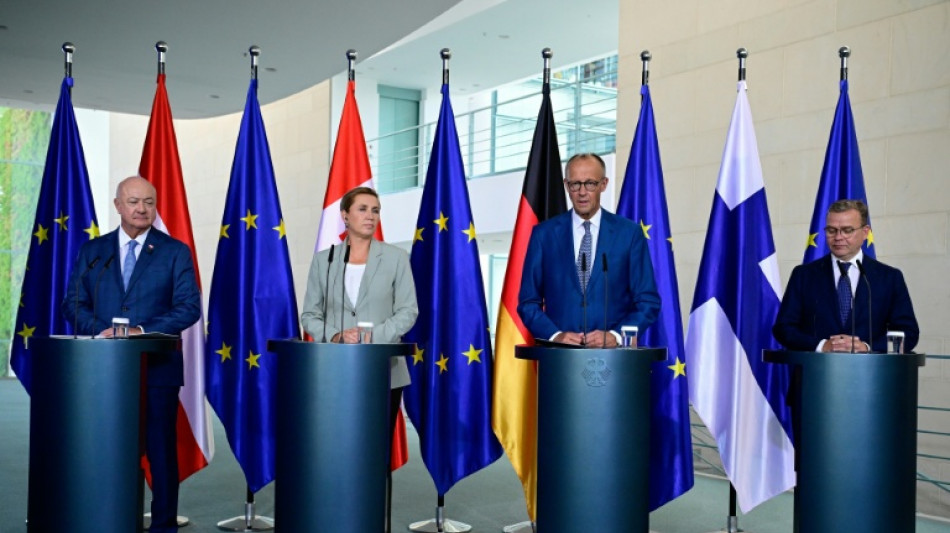
Germany-led 'frugal' EU states demand budget plan cuts of 'several hundred billion' / Photo: Tobias SCHWARZ - AFP
Germany and five other so-called "frugal" EU members demanded Thursday that the European Commission's seven-year budget proposal of nearly two trillion euro ($2.3 trillion) be slashed by "several hundred billion euros".
Germany's conservative Chancellor Friedrich Merz hosted the leaders of Austria, Denmark and Finland for talks in Berlin, which their Dutch and Swedish counterparts joined via video link.
Their meeting aimed to send a joint message as the 27-member European Union braces for tough negotiations to agree on a budget for the bloc for 2028-34.
Merz has long demanded the European Commission dramatically cut its record budget proposal, calling the plan "unaffordable".
On Thursday, all six leaders agreed in a joint statement that the "proposal of nearly two trillion euros needs to be reduced by several hundred billion euros in a balanced manner".
They said the so-called Multiannual Financial Framework should be guided by the EU's "shared priorities" of security and defence, competitiveness, migration and sovereignty.
"At a time when virtually all member states are undertaking painful fiscal consolidation, the EU budget cannot be an exception," they said.
"We are not stingy," Merz told a press conference, "but the kind of allocations proposed by the Commission simply do not fit the times we live in."
He added that the six countries represented in the talks "finance around 40 percent of the European budget" and the lion's share of European support for Ukraine.
"We want realism and reforms," said Merz. "We will not be able to meet the challenges of the 21st century with a 20th-century budget."
- 'Russia is threatening us' -
The EU's "frugal" members traditionally find themselves at odds with countries including Italy, Spain and Poland which support a bigger budget.
They also want a greater spending focus on defence, at a time when NATO faces a hostile Russia, and to boost European competitiveness against the United States and China in key industries and technologies.
Danish Prime Minister Mette Frederiksen said "the EU budget must prioritise European defence and security, continue to provide strong support for Ukraine and support protecting our external borders".
"Russia is threatening us and testing us," she said.
"We have seen hybrid attacks across Europe almost on a daily basis now. We need to rearm ourselves and continue our steadfast support to Ukraine. More weapons, more ammunition. And we also need to secure our borders."
European Council chief Antonio Costa kicked off a tour of EU capitals this week bidding to hammer out a compromise on the budget -- with the clock ticking down to a December deadline.
The EU wants a budget agreed before 2027, when elections in several member states -- including key power France, where the far right is riding high -- could complicate any grand bargain.
The arm-wrestling will kick off in earnest at a Brussels summit in October, with a likely second meeting in November, before a grand finale in December when leaders will look to seal the deal.
Merz already called on the EU executive to reduce its initial budget plan, speaking in Dublin late last month alongside Micheal Martin, prime minister of current EU presidency-holder Ireland.
The chancellor also said then that it was "unacceptable" to add 2,500 new jobs at EU institutions and urged a "thorough reduction in bureaucracy".
The six leaders in their joint statement also said that "we expect the EU institutions to organise their workload within the existing staff levels".
And they stressed their long-held position that "new common borrowing is not the solution to our budgetary challenges and is no alternative to structural reforms".
T.Abato--IM