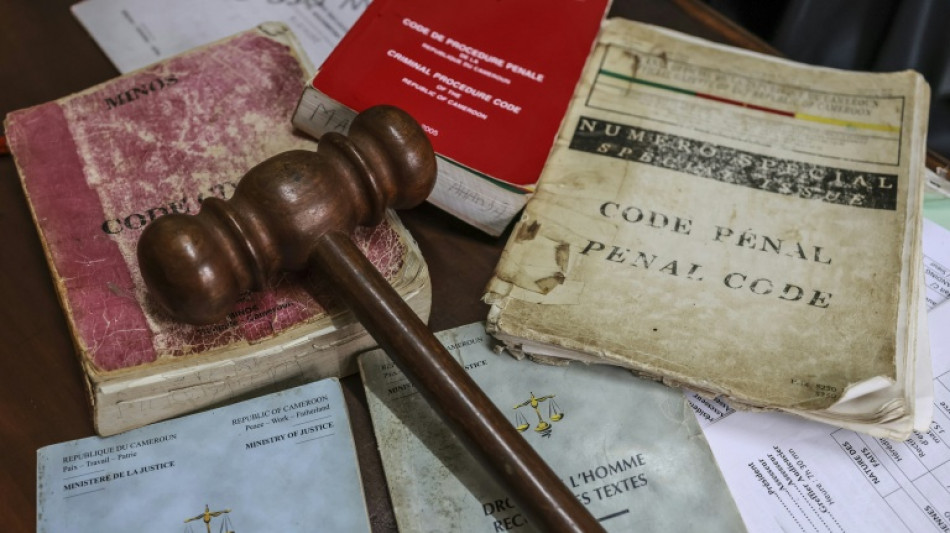
Families demand justice for Cameroon's 'nightmare' wave of murdered women / Photo: Daniel BELOUMOU OLOMO - AFP
Courage Anushuni still cannot make sense of his pain after his mother Cameroonian teacher Geraldine Achia was beaten to death, with her husband the prime suspect.
"Having lost my mother is a nightmare. The shock is overwhelming. I cannot believe what happened," said the 18-year-old, Achia's only son, choking up as the words came out.
Anushuni is far from alone in the central African country where gender-based violence is on the rise.
Between January and April, around 50 femicides were recorded in Cameroon, according to the ministry for women and the family.
The figure matches that for the whole of 2023, climbing to 67 femicides reported in 2024 and 77 last year.
Last month alone saw nearly 10 women killed, the Stop Feminicides 237 (Stop Femicide 237) organisation said.
The growing toll has sparked anger from rights groups and the opposition, who accuse 93-year-old President Paul Biya's government of inaction.
Even Ajara Nchout Njoya, star striker on the Cameroon national women's football team, has spoken out, with her criticism of the "tragic wave" of femicides going viral on social media.
"Being a woman in Cameroon should never be a risk," she wrote in late August.
- 'Jaw broken' -
At the home of Achia's older sister in Emana, a working-class neighbourhood of the Cameroonian capital, Yaounde, relatives set about organising her funeral, while struggling with the loss.
Surrounded by her family, Regina Mbatiabuh Ngukum became emotional as she described arriving at hospital to find her sister's body laid under a sheet.
"I saw her disfigured face, covered with bruises from the blows, her mouth torn up and her jaw broken," she told AFP.
Achia, who was in her 30s, met her husband in December and they married in a traditional wedding in July.
On the night she was killed between September 5 and 6, he said the pair got into an argument after Achia went on a night out, following which she came home with a half-empty beer bottle in her hand.
Her sister, who is adamant that Achia did not go out drinking, disputes that version of events.
At the hospital, she recovered her sister's phone and discovered, while still in shock, a series of photos with Achia's face covered in bruises.
- A murder every 10 minutes -
Senator Francoise Puene, who has been involved in the struggle for women's rights for years, said several issues were behind the rise in murders.
"Women are speaking out more and more, but the economic crisis is also a factor. Since the onset of the Covid-19 pandemic, violence has escalated," the politician said.
Through her centre, Puene said she had helped more than 5,000 women become independent through small-scale loans, while teaching more than 300,000 people about women's rights.
"According to the statistics, we're seeing a murder every 10 minutes," she told AFP.
"Just since you started interviewing me, two women have been murdered," she said.
Psychiatrist Laure Justine Menguene blames a patriarchal society and a violent education where men "grow up with the idea that they are superior to women".
Viviane Tathi Yende, whose Stop Feminicides 237 organisation has recorded 56 killings since the beginning of 2026, points the finger at alcohol and drug abuse, economic issues, tensions between traditional and modern ways of life and a feeling that abusers escape punishment.
"There is a great deal of impunity and a taboo around prosecuting the perpetrators of violence. Time and time again, the preference is for an out-of-court settlement," she lamented.
- 'Justice be done' -
At the heart of the debate is how woman-killers are tried in the Cameroonian courts.
The law currently does not recognise femicide as a separate crime from murder.
"As long as there is no specific law, each judge will base their rulings on the facts presented to them and the criminal code," argues investigating magistrate Martine Ahanda Tana.
For the judge, a law clearly defining femicide as a separate crime would allow the killing of women to be punished appropriately.
In response to the outcry, the family and women's ministry announced last month that a bill on the issue -- which has been in the works for years -- will be considered during parliament's November session after gaining widespread support.
But the sluggish pace of progress has been condemned.
The opposition MRC party has criticised the "criminal passivity" of the government of Biya, who has ruled Cameroon with an iron fist for nearly 44 years.
After several women were murdered between August 6 and 26 -- some in the presence of their children -- Human Rights Watch urged the authorities to take immediate action against gender-based violence.
"These killings are the latest signs that women in Cameroon, including domestic violence victims and survivors, have little protection or access to justice," the watchdog said.
It accused the government of having "made a lot of promises to women" without keeping them.
The scourge is a continent-wide one: Africa has the highest femicide rate in the world, according to the United Nations, with three cases per 100,000 women, compared with 0.5 in Europe.
Several days after Achia's death, her husband, who denies having killed his wife, was arrested more than 300 kilometres (186 miles) away from Yaounde and remains in detention.
Anushuni, who faces having to bury his mother, has but one wish: "that justice be done".
L.Amato--IM