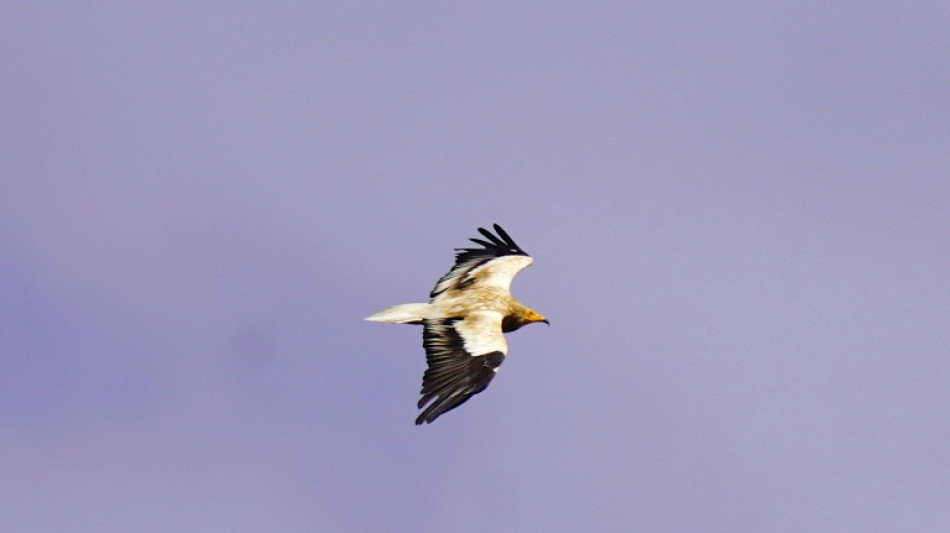
War imperils rare vultures' yearly odyssey to the Balkans / Photo: Raimond Kola - AFP
Endangered Egyptian vultures, with their vivid yellow face and white plumes, would usually be nesting across the Balkans in their dozens by April.
But experts tracking the rare birds say local teams have struggled to find more than a handful in recent weeks, raising fears that the wars in the Middle East may have further disrupted their already perilous journey from Africa.
"The war is adding to the risks already present along this species' migration route," Nikolai Petkov, project manager at the Bulgarian Society for the Protection of Birds, told AFP.
From electrocution to poaching, the scavenger faces many hazards on its 5,000-kilometre (3,100-mile) annual migration to its Balkan breeding sites.
"The Middle East is a crucial migration corridor, and the war can have a considerable impact on this already sharply declining population," said Xhemal Xherri from the group Protection and Preservation of Natural Environment in Albania (PPNEA).
With thousands of people killed in bombing campaigns and the threat of further military action, any information on the impact on wildlife is hard to find, even for experts.
"Bombardments disturb not only Egyptian vultures, but also many other birds," he said, warning that the decline of the specific species could be a wider signal.
- A stark decline -
In the last 30 years, their numbers have fallen by 80 percent in the Balkans, according to Petkov, and the International Union for Conservation of Nature classifies the species as endangered worldwide.
Due to their key role in clearing carcasses -- which prevents the spread of disease -- conservationists and NGOs have long pushed efforts to protect the animal across their range.
Protecting resting places along with breeding programmes has helped their numbers improve slightly in Bulgaria, where the majority of the vultures now nest in the Balkans, Petkov said.
But they remain particularly vulnerable to accidental poisoning from bait use on farmland, which often means the birds eat tainted carrion.
- A hopeful wait -
In the rugged wilderness of southern Albania, the shepherds of Salaria are usually the first to notice the vultures return as a signal of the coming European spring.
As the season nears its end, they have recently spotted two soaring over their flocks.
Even for experts like Xherri, it took hours of scouring mountainous nesting sites to confirm the shepherds' report.
"Good news!" he exclaimed, as he squinted through binoculars at the white dot descending onto a ledge about 400 metres up a rockface.
He would have another long wait before confirming that a second of Europe's smallest vultures had also safely returned to its lofty perch.
The painstaking nature of the work makes it almost impossible to know how many animals actually reached nests in Albania, even before the war.
But Petkov remained optimistic, suggesting they may have delayed their journey due to colder weather earlier this year.
"So they might be a bit late, but hopefully, as we often say, you count the birds in autumn."
O.Esposito--IM