Loss and laughter: war medics heal in west Ukraine mountains / Photo: Roman PILIPEY - AFP
Ukrainian war medic Roma Zukh has learned a hard rule during the Russian invasion -- don't get too close to your colleagues. They could be killed at any moment.
Since Russia invaded in February 2022, the former truck driver, with light blue eyes and a ginger beard, had lost too many people to see any new friends suffer the same fate.
"You remember each one... the ones you were wounded with, the ones that enlisted at the same time -- those you definitely won't forget," the 37-year-old said.
"Now I try to keep my distance, as I get very attached," he said, having recently joined a new battalion.
"I don't sit at the same table for lunch, for example."
The gruesome toll of the war is a daily reality for Ukraine's hundredsof combat medics -- with the sights, sounds and smells of the front weighing heavily on their mental health.
Over 1,000 kilometres (620 miles) away from the battlefield at a 10-day mountain retreat, designed to help them recover, Roma's rule was being put to the test.
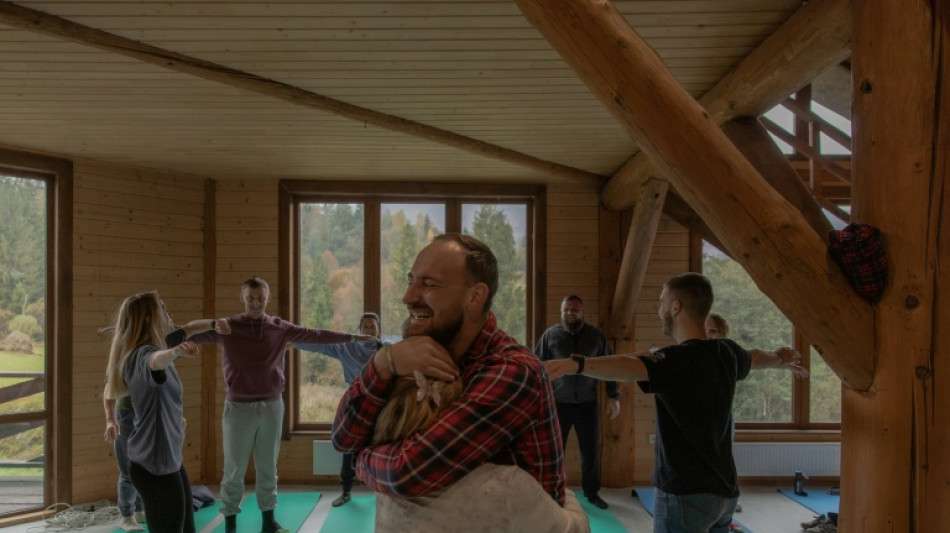
Taking place in wooden chalets in the Carpathians, the RePower programme was much like a children's holiday camp, featuring pottery classes, hikes and even sushi-making lessons.
For some, the relief is instant.
When the car carrying Dmytro Kunytskyi started climbing into the mountains, bright with autumnal orange and green trees, the 20-year-old medic was struck by a long-forgotten feeling.
"We opened the windows and the air filled with the smell of pine," he said.
"We were just very happy, like little kids."
- 'Every breath' -
But completely leaving the front line was not easy.
Kunytskyi was often on the phone, delegating tasks to his team on the front.
He has been serving for two years in a role that requires him to retrieve and examine the corpses of comrades killed in battle.
"I get flashbacks. Times when the smell of blood is so sweet that you feel poisoned, when you don't have any chance to immediately wash it off. And with every breath you take, you smell blood."
"But deaths, smells. That's just nothing compared to having to lose so many friends," he said, his eyes rimmed in dark, red circles.
The psychologists working with the medics at the camp say they face a difficult challenge.
The medics would soon go back to the front, making in-depth therapy risky.
"To delve into trauma, we need time to stabilise people," Andrii Anpleiev, a doctor, told AFP.
"This is something new -- working with trauma when the traumatic conditions are still ongoing."
They instead focused on giving medics concrete tools to regulate their emotions and introduce them to the benefits of therapy.
They also created spaces where people could feel safe, for once.
At a "sound-healing" experience, a dozen medics lay on yoga mats, relaxing to the sound of waves lapping on a beach and forests filled with chirping birds.
Suddenly, a growling snore threatened to break the tranquillity.
Zukh had fallen asleep.
Lying tucked in blankets, the others suppressed smiles, trying to stay in the moment.
"The temptation was great, but I tried not to laugh at him," Kunytskyi said at the end of the session, as everyone cracked up.
- 'Blood' -
After evening sessions with a psychologist, the medics dined in a local restaurant decorated with mountain paintings and fairy lights.
The war dominates even this downtime -- evident during a game of Alias, where players try to explain random words to their teammates.
"We don't have enough of it," one said.
"Blood!" the team shouted.
An attempt to mime the word "shorts" by slicing imaginary trousers fell flat.
"Tourniquets!" the team guessed, thinking about the devices tied around limbs to halt massive bleeding.
Within just a few days, the medics had grown tight, forming a WhatsApp group to stay connected once they returned to the front.
Zukh pledged to stay in contact too, even if he couldn't shake his concern.
"How could I not worry about them? Of course I worry, but they'll be fine. I hope."
M.Fierro--IM