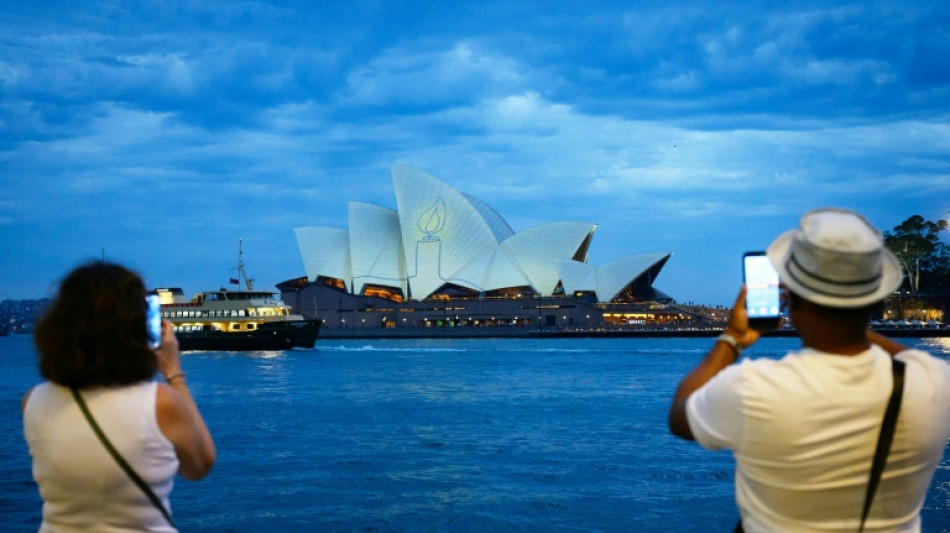
Australia pauses for victims of Bondi Beach shooting / Photo: GEORGE CHAN - AFP/File
Australians will light candles and fall silent Thursday on a national day of mourning for the 15 people killed by gunmen who opened fire on a Jewish festival at Bondi Beach.
As flags fly at half mast, millions are being asked to observe a minute's silence at 7:01 pm east coast time (0801 GMT) for victims of the December 14 mass shooting, Australia's deadliest in three decades.
Candles will be lit in windows and on doorsteps around the country.
Survivors, families, emergency responders, and community leaders are to join in an evening of collective mourning for those killed, titled "Light Will Win", at Sydney's Opera House.
Sajid Akram and his son Naveed allegedly shot into crowds at a Jewish Hanukkah celebration on the Sydney beach, inspired by extremist Islamic State ideology.
Among the victims were an 87-year-old Holocaust survivor, a couple who confronted one of the gunmen, and a 10-year-old girl, Matilda, described at her funeral as a "ray of sunshine".
- Antisemitism -
Despite the dangers of that day, first responders raced to treat the wounded; strangers sheltered each other from gunfire; and shop owner Ahmed al Ahmed famously wrested a gun from one of the attackers.
Prime Minister Anthony Albanese, who is to address the Opera House event, has faced criticism for alleged foot-dragging in combating antisemitism ahead of the attack.
Since the shooting, he has agreed to establish a high-level royal commission inquiry, which is to include examinations of the security services' actions, and rising reports of antisemitism.
This week, his left-leaning Labor government ushered through parliament new laws that seek to tighten gun control and crack down on crimes of hate speech and radicalisation.
On hate speech and radicalisation, the legislation stiffens sentences, sets up a framework for listing prohibited hate groups, and makes it easier to reject or cancel visas for suspects.
On firearms, Australia will set up a national gun buyback scheme, tighten rules on imports of the weapons and expand background checks for gun permits to allow input from the intelligence services.
- Security questions -
Gunman Sajid Akram, 50, was shot and killed by police during the Bondi Beach attack. An Indian national, he entered Australia on a visa in 1998.
His 24-year-old son Naveed, an Australian-born citizen who remains in prison, has been charged with terrorism and 15 murders.
Police and intelligence agencies face difficult questions about whether they could have acted earlier to prevent the shooting.
Naveed Akram was flagged by Australia's intelligence agency in 2019, but he slipped off the radar after it was decided that he posed no imminent threat.
The Akram duo travelled to the southern Philippines in the weeks before the shooting, fuelling suspicions they may be linked to Islamist extremists.
But Australian police say the evidence so far suggests they acted alone.
C.P.Ajello--IM