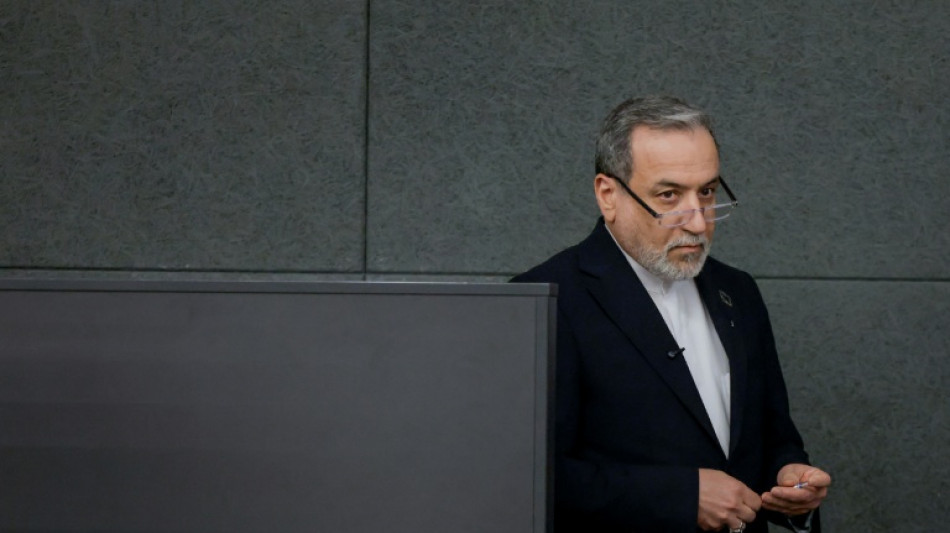
Iran, US agree on 'guiding principles' for deal at Geneva talks: Iran FM / Photo: Valentin Flauraud - AFP
Iran and the United States agreed to "a set of guiding principles" laying the groundwork for a broader deal during talks in Geneva on Tuesday, Tehran's top diplomat said, after the leaders of both countries traded warnings of military action.
The Omani-mediated talks were aimed at averting the possibility of US military intervention to curb Iran's nuclear programme, while Tehran is demanding the lifting of US sanctions that are crippling its economy.
Iran's supreme leader had warned earlier in the day that the country had the ability to sink a US warship recently deployed to the region, while President Donald Trump alluded the day before to unspecified "consequences" should the two sides fail to strike a deal.
"Ultimately, we were able to reach broad agreement on a set of guiding principles, based on which we will move forward and begin working on the text of a potential agreement," Foreign Minister Abbas Araghchi told state TV after Tuesday's talks, which he described as "more constructive" than the previous round earlier this month.
He added that once both sides had come up with draft texts for an agreement, "the drafts would be exchanged and a date for a third round (of talks) would be set".
Araghchi acknowledged, however, that it "will take time to narrow" the gap between both countries' positions.
Omani Foreign Minister Badr Albusaidi said the two sides had made "good progress", but likewise cautioned "much work is left to be done".
Trump has repeatedly threatened military action against Iran, first over Iran's deadly crackdown on protesters last month and more recently over its nuclear programme.
Washington has ordered two aircraft carriers to the region as it piles on pressure. The first -- the USS Abraham Lincoln, with nearly 80 aircraft -- was positioned about 700 kilometres (435 miles) from the Iranian coast as of Sunday, satellite images showed.
Its location puts at least a dozen US F‑35s and F‑18 fighter jets within striking distance. A second carrier was dispatched over the weekend.
"I don't think they want the consequences of not making a deal," Trump told reporters ahead of the talks.
But Khamenei followed up with tough talk of his own after the negotiations began, saying Iran possessed weapons able to sink an American warship.
"We constantly hear that they have sent a warship towards Iran. A warship is certainly a dangerous weapon, but even more dangerous is the weapon capable of sinking it," he said in a speech.
He added that Trump would not succeed in destroying the Islamic republic.
Iran has insisted the talks be limited to the nuclear issue, though Washington has previously pushed for other topics to be discussed, including Tehran's ballistic missiles programme and support for armed groups in the region.
Foreign ministry spokesman Esmail Baqaei on Tuesday said the lifting of sanctions must be an integral part of any deal.
- War games -
Iran has also sought to display its military might, with its Islamic Revolutionary Guard Corps beginning a series of war games on Monday in the Strait of Hormuz to prepare for "potential security and military threats", Iranian state TV said.
Iranian politicians have repeatedly threatened to block the strait, a strategic route for oil and gas.
On Tuesday, state TV reported that Tehran would close parts of the waterway for "safety" reasons during the drills.
A previous attempt at diplomacy collapsed last year when Israel launched surprise strikes on Iran in June, beginning a 12-day war that Washington briefly joined to bomb Iranian nuclear sites.
US Secretary of State Marco Rubio told reporters on Monday: "We're hopeful there's a deal."
His counterpart Araghchi had said before the talks that he too had come to "Geneva with real ideas" for a deal, but added there would be no "submission before threats".
The West fears Iran's nuclear programme is aimed at making a bomb, which Tehran denies.
Araghchi met in Geneva on Monday with the head of the International Atomic Energy Agency, Rafael Grossi, "for deep technical discussion".
Washington has dispatched Middle East envoy Steve Witkoff and Trump's son-in-law Jared Kushner to Geneva.
On Friday, Trump had said a change of government in Iran would be the "best thing that could happen".
Ali Fathollah-Nejad, director of the Berlin-based Centre for Middle East and Global Order, said Iran was faced with an "existential dilemma".
"Giving in to US demands could bring sanctions relief that it would desperately need to stabilise the regime and fund its repressive apparatus," he told AFP.
"However, any significant concessions on the nuclear, ballistic missile and regional proxies issues would sensitively undermine its ideological and military standing."
J.Romagnoli--IM