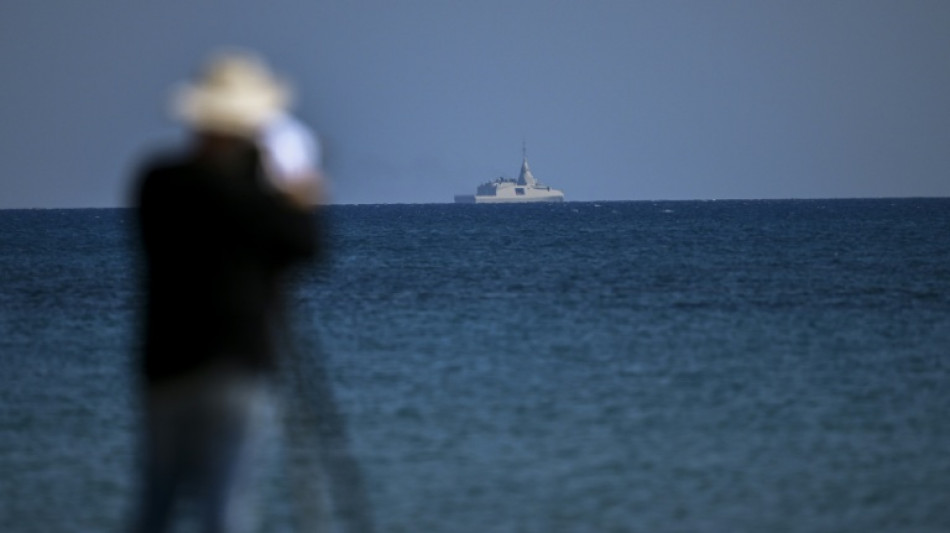
Wary Europeans pledge 'defensive' military aid in Mideast war / Photo: Jewel SAMAD - AFP
Wary of getting directly involved in the US-Israeli war with Iran, European countries are nevertheless being drawn into the conflict following attacks on Cyprus and Western allies in the Gulf.
While underlining their "defensive" aims, several European countries have now pledged military assistance to EU member Cyprus as the Middle East conflict intensifies and widens.
Some are also allowing the US military to use their bases under certain conditions, such as not using them to launch bombing raids.
"We are not at war and we do not want to join the war," Italian Prime Minister Giorgia Meloni told RTL 102.5 radio on Thursday.
Here are the main military assistance pledges from Europe so far:
- Britain -
An Iranian-made unmanned drone struck the runway at the British air force base at Akrotiri in Cyprus on Monday.
Other drones, probably launched by Iran-backed military group Hezbollah from Lebanon, have been intercepted.
In response, Britain said it was sending a warship, HMS Dragon, fitted with a Sea Viper missile system able to launch eight missiles in under 10 seconds.
It is also deploying Wildcat helicopters equipped with Martlet missiles that can take down drones.
Separately, Prime Minister Keir Starmer said on Thursday that four Typhoon fighter jets would be sent to Qatar.
Starmer initially refused to have any role in the war but later agreed to a US request to use two British military bases for a "specific and limited defensive purpose".
Starmer's initial refusal incurred the wrath of US President Donald Trump.
"This is not Winston Churchill that we're dealing with," Trump said on Tuesday.
- France -
France is sending its flagship aircraft carrier -- the Charles de Gaulle -- to the eastern Mediterranean.
It has 20 Rafale fighter jets on board along with two Hawkeye radar aircraft.
French President Emmanuel Macron has also said Paris will dispatch additional air defence units to Cyprus.
He said that "Rafale jets, air-defence systems and airborne radar aircraft" were being deployed in the region.
France has already deployed its frigate, the Languedoc, off Cyprus.
The ship used its Aster missiles to shoot down drones fired from Yemen by Iran-allied Huthi rebels targeting vessels in the Red Sea in December 2023.
France said US military support jets have been allowed to use the Istres air base in France with "full guarantees" they were not involved in Iran strikes.
- Greece -
Greece has sent two frigates and four F-16 fighter jets to Cyprus.
It has also allowed the US to use its base in Souda Bay in Crete.
- Italy -
Rome has said it will send "naval assets" to Cyprus in the coming days along with France, the Netherlands and Spain.
Italy has also pledged "air-defence, anti-drone and anti-missile systems" to partners in the Gulf.
Italian media have reported that the assistance could include the SAMP/T air defence system.
Defence Minister Guido Crosetto said Italy's air bases could be used by the US for "logistical support" for "aircraft not intended for combat" under existing agreements.
- Portugal -
The Portuguese government has given the go-ahead for the US to use its Lajes base in the Azores as part of operations targeting Iran but only with certain conditions.
Prime Minister Luis Montenegro said on Wednesday that permission had been granted "on the understanding that these operations are defensive or retaliatory in nature, that they are necessary and proportionate, and that they target exclusively military objectives".
- Spain -
Spanish Prime Minister Pedro Sanchez has made clear his opposition to the war in a verbal bust-up with Trump.
Madrid has ruled out allowing US military use of Spain's bases, prompting a threat from Trump to sever all trade ties with Spain.
Spain has nevertheless said it will send its most advanced frigate -- the Cristobal Colon -- to protect Cyprus.
The defence ministry said on Thursday that the warship would "offer protection and aerial defence" and "support any evacuation of civilians".
L.Bernardi--IM