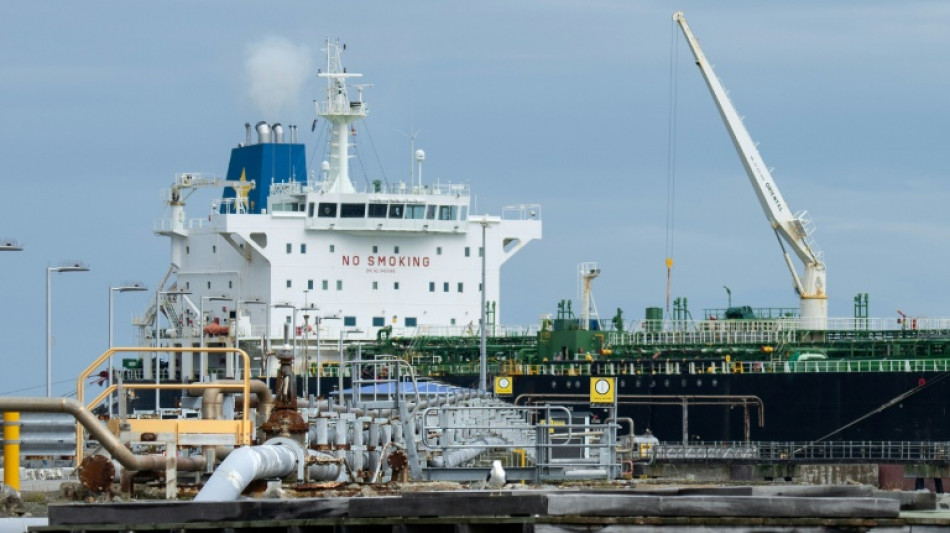
Ship insurers juggle war risks for perilous Gulf route / Photo: Marty MELVILLE - AFP
Iranian forces' threat to ships in the crucial Strait of Hormuz has driven up payments for the insurance that underpins the world freight industry.
Here are facts and figures about how maritime insurance works -- and the impact from the war sparked by US-Israeli strikes on Iran, which has virtually cut off shipping in the strait.
- Insurance available -
After the fighting broke out on February 28, some insurers served so-called cancellation notices for war risk policies to "reassess... and then reinstate that cover at adjusted terms", the International Union of Marine Insurance said in a statement.
Despite the name, "a 'Notice of Cancellation' does not, necessarily, end the cover. War cover remains available for owners and operators wishing to take it."
Executives in London -- the world's top shipping insurance market -- insisted captains were avoiding the route to protect their crews, not because they could not get insured.
"Safety concerns, not insurance availability, (are) driving reduced vessel traffic," headlined the Lloyd's Market Association (LMA), a trade body for the London ship insurance industry, in a report.
The price of such policies to cross the strait has shot up, however, according to industry players.
- Surging premiums -
Before the current Middle East conflict, a war risk premium would typically have cost less than one percent of the vessel's so-called hull value.
Now, war risk insurance could run into tens of millions of dollars for a single trip through the Hormuz Strait.
Premiums have surged for ships seeking special cover to cross the strait, according to Robert Peters of UK maritime consultancy Ambrey, which has an insurance arm.
"I'm not sure the market has settled on an agreed range," he added, noting figures typically range "from five percent down to one percent".
David Smith, head of the marine arm at specialist insurance broker McGill, meanwhile estimated it at "anywhere between three and-a-half and 10 percent".
"It is going up and down almost on an hourly basis," he told AFP.
Cargo insurance rates have followed the same trajectory.
"A brand new LNG (liquefied natural gas) ship could be worth $200 million to $250 million alone, and then a cargo could be worth the same again," Smith noted.
- Five-fold cover -
Commercial ships typically need several separate insurance policies.
Hull cover insures against loss or damage to the vessel, while protection and indemnity (P&I) acts like third-party liability coverage.
The cargo on board -- from petrochemicals to containers -- also requires insurance.
In addition, ships need war risk insurance -- typically an annual premium -- but that does not cover ships entering the most active conflict zones, known as "listed" areas.
To do that, they must renegotiate another war risk premium.
"The annual (war risk) premium is not designed for a crisis," said Neil Roberts, head of marine and aviation at the LMA.
- Danger zones list -
In early March, London's marine insurance market widened the "listed" areas in the Gulf region.
The system "enables underwriters to respond quickly and proportionately to areas of increased risk", said Roberts, who sits on the committee that updates the list.
To price war risk premiums, underwriters are considering numerous factors such as the type, flag and owner of the vessel, as well as its size, speed and cargo.
"We have seen some quotes where the underwriter has actually warranted that the vessel goes through at... full throttle," said Smith.
"That is deemed to be an improvement in the risk factor."
- No buyers -
Ships normally have 24 hours to buy insurers' quotes for listed area entry, but that has narrowed to 12 hours for Hormuz, Smith said.
"You line your ship up, you turn the engine on, you get ready to make a charge, then you'll get your quote," he said.
But currently "no one is buying", he added, saying one underwriter reported to him less than one-percent uptake for Hormuz-related policies.
- US insurance scheme -
A US shipping insurance initiative to boost Hormuz crossings will begin operating soon, Treasury Secretary Scott Bessent said Thursday.
US President Donald Trump previously announced the scheme would involve naval escorts and urged Western and other powers to step up. But they have proved unwilling while the conflict rages.
If a crossings framework with military protection could be agreed and proven effective, insurance "rates would tumble very, very quickly" Smith predicted.
P.Conti--IM