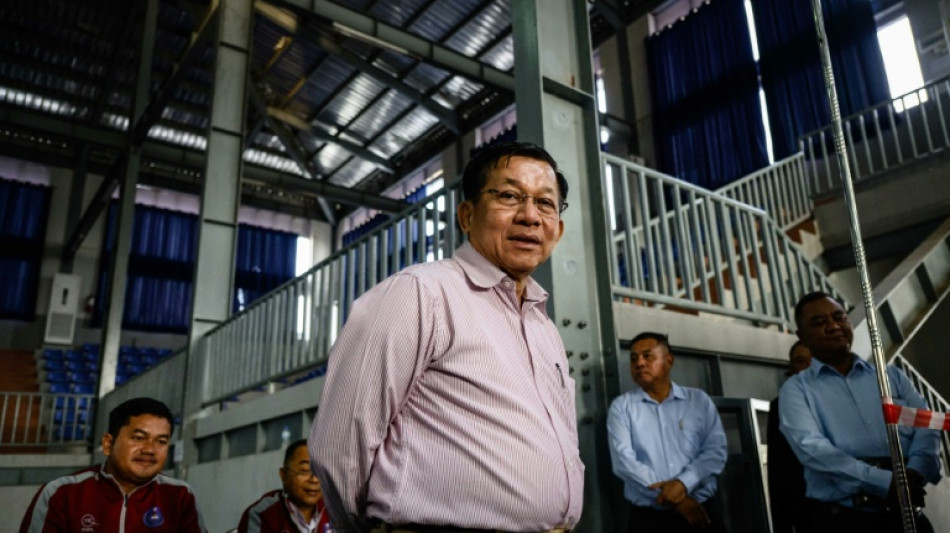
Myanmar junta chief elected president by pro-military MPs / Photo: ANTHONY WALLACE - AFP/File
Myanmar's pro-military lawmakers elected junta chief Min Aung Hlaing as president on Friday, with the ex-armed forces commander set to maintain his rule in a civilian guise after snatching power by force five years ago.
The coup-leading general ousted the elected government of Aung San Suu Kyi in 2021, triggering a civil war that has killed tens of thousands of people.
Parliament speaker Aung Lin Dwe announced Min Aung Hlaing was elected president, chosen by military-aligned MPs installed in a recent election overseen by the junta he leads.
Min Aung Hlaing secured 429 of 584 votes cast in the upper and lower houses of parliament in the capital Naypyidaw on Friday, a parliament official said.
While the junta touted parliament's reopening last month as a return of power to the people, analysts describe it as civilian window dressing intended to launder the military's continuing rule.
"There is no hope for the country under his presidency. The country will only get worse," said a 50-year-old Yangon resident, who spoke on condition of anonymity due to security concerns.
"I never expected anything from this government anyway," she said, adding it was formed through "fake elections".
The pro-military Union Solidarity and Development Party (USDP) won more than 80 percent of parliamentary seats contested in the phased poll that concluded in January. Serving members of the armed forces also occupy unelected seats making up a quarter of the total.
The massively popular Suu Kyi has been detained since the February 2021 coup, her party dissolved, criticism or protest over the election outlawed and voting blocked in territories controlled by rebels fighting the military.
The conflict and ensuing humanitarian crisis show no sign of abating, with opposition factions still standing defiant after the poll.
Rights campaigners Burma Campaign UK said the Myanmar military would never reform.
"The only thing that changes are the forms of political system it uses to ensure its survival, and the tactics it uses to try to relieve pressure from the domestic population and international community," it said in a statement.
Analysts say the decision by Myanmar's top brass to cloak its command in civilian dress gives some regional partners cover to engage with and invest in a country that many Western nations consider a pariah.
Key junta ally China congratulated Min Aung Hlaing on Friday on his election win and pledged "high-quality" cooperation on Beijing's Belt and Road infrastructure projects.
"China supports the new Myanmar government in safeguarding national peace and stability, and realising development and prosperity," Chinese foreign ministry spokeswoman Mao Ning told reporters.
- Civilian leader -
Min Aung Hlaing is expected to be sworn in as president next week.
He served as both commander-in-chief of the armed forces and acting president in a post-coup period of emergency rule, but he is constitutionally compelled to relinquish his military post to become president.
Min Aung Hlaing handed the military baton over to loyalist and former spymaster Ye Win Oo on Monday.
Myanmar's military has ruled the restive Southeast Asian nation for most of its post-independence history and presents itself as the only force guarding it from rupture and ruin.
The generals loosened their grip for a decade-long democratic interlude beginning in 2011, allowing Suu Kyi to ascend as civilian leader and steer a spurt of reform as the nation opened up from its hermetic history.
Min Aung Hlaing snatched back power, making allegations of massive voter fraud, after the Nobel Peace Prize laureate's party trounced the pro-military USDP with a landslide victory in 2020 elections.
Analysts say the claims were unfounded and that he acted out of anxiety about the armed forces' waning influence.
The new government is expected to march in lockstep with the top brass now that the USDP is entrenched in parliament with back-up from the unelected military lawmakers.
S.Carlevaro--IM