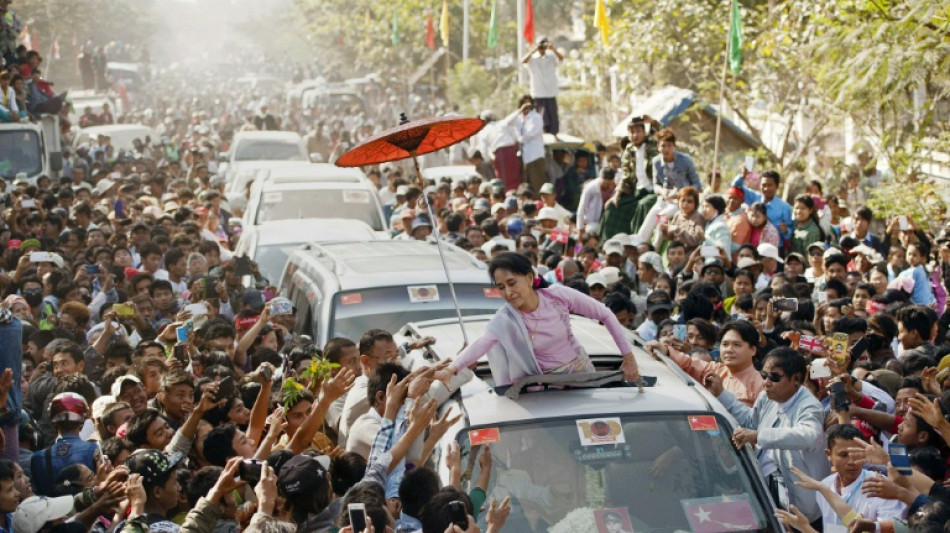
Myanmar's Suu Kyi back in the spotlight but still out of sight / Photo: Ye Aung Thu - AFP/File
Ousted Myanmar leader Aung San Suu Kyi has been in detention since a 2021 military coup, with her announced movement to house arrest a tantilising update that still leaves her isolated from the public eye.
The Nobel Peace Prize laureate was once the darling of foreign diplomats, with legions of supporters at home and a reputation for redeeming Myanmar from a history of iron-fisted martial rule.
As her administration was felled, a decade-long democratic experiment was halted and activists rose up -- first as street protesters and then as guerrilla rebels battling the military in an all-consuming civil war.
Myanmar leader Min Aung Hlaing -- who ordered the coup deposing Suu Kyi and now serves as civilian president -- on Thursday said she would serve the remainder of her sentence at a "designated residence".
It was not immediately clear where that would be or how long she has yet to serve.
- Accidental icon -
Suu Kyi has spent around two decades of her life in detention ordered by the military -- but in a striking contradiction, she is the daughter of the founder of Myanmar's armed forces.
She was born on June 19, 1945 in Japanese-occupied Yangon during the final weeks of World War II.
Her father, Aung San, fought for and against both the British and the Japanese colonisers as he sought to secure independence for his country.
He was assassinated in 1947, months before the goal was achieved, and Suu Kyi spent most of her early years outside Myanmar -- first in India, where her mother was an ambassador, and later at Oxford University, where she met her British husband.
After General Ne Win seized power in 1962, he forced his brand of socialism on Myanmar, turning what was once Asia's rice bowl into one of the world's poorest and most isolated countries.
Suu Kyi's elevation to a champion of democracy happened almost by accident when she returned home in 1988 to nurse her dying mother.
Soon afterwards, at least 3,000 people were killed when the military crushed protests against its authoritarian rule -- a catalyst moment for Suu Kyi.
A charismatic orator, the then-43-year-old found herself helming a burgeoning democracy movement, but was put under house arrest in 1989.
Her National League for Democracy party nonetheless surged to a landslide election victory in 1990. But the generals were not prepared to give up power.
Suu Kyi spent around 15 of the following 20 years in detention, largely at her Yangon home where she often roused crowds with speeches over her boundary wall.
The junta offered to end her imprisonment at any time if she left the country permanently, but Suu Kyi refused and was awarded the Nobel Peace Prize while detained in 1991.
Her campaign took a heavy toll -- she missed her husband's death from cancer in 1999 and much of her two sons' childhoods.
This time, a source from her party said they expected her to be kept in the sparse and sprawling capital Naypyidaw.
- Rank and file -
The military eventually granted her freedom in 2010, just days after elections her party boycotted, but which brought in a nominally civilian government.
She became an MP in a 2012 by-election, cultivating a saint-like reputation among followers who refer to her simply as "The Lady" or "Aunty".
Her movement swept the next poll three years later, prompting jubilant celebrations by massive crowds, a flurry of visits from long-absent foreign leaders and a striking mood of public optimism.
But there was global revulsion at a 2017 army crackdown that forced roughly 750,000 members of the Rohingya minority to flee to neighbouring Bangladesh.
Her government appeared in lockstep with the military, denying claims the Rohingya suffered rape, extrajudicial killings and arson attacks.
Suu Kyi travelled to The Hague to rebut charges of genocide against them at the UN's top court in 2019 -- tanking her reputation on the international circuit.
But her relationship with the powerful military establishment remained fraught and they snatched back power after the 2020 vote, claiming fraud had marred the poll.
F.Lecce--IM