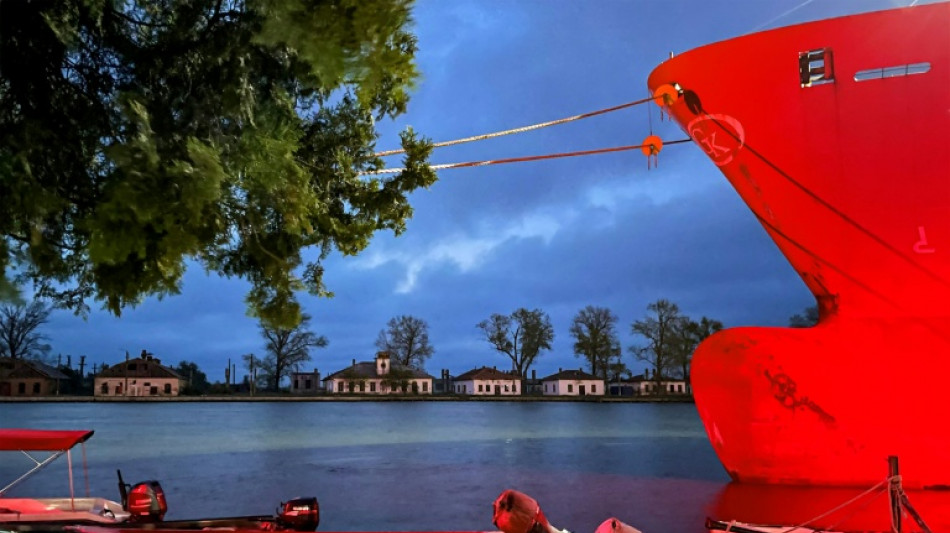
At Romania's edge, quiet life meets threat of war / Photo: Daniel MIHAILESCU - AFP
When drones strayed over the Danube and crashed in Romania, Roxana Saraev felt uneasy. But ensconced in her seaside jewellery shop at the country's easternmost tip, she has made up her mind -- she is not going anywhere.
For the 32-year-old, her adopted home of Sulina remains an "oasis of tranquility" despite the war in Ukraine a few miles away.
The conflict is "looming as a threat" in her mind, creating "a feeling of unease," she told AFP. But having moved to Sulina five years ago, she opened the colourful store in February -- a testament to her will to stay.
Reachable only via the river, Sulina was its normal quiet self when AFP visited the city in May. No air raid alerts rang out and no explosions boomed across the border.
But the area is not always so calm, said Catalin Cosma, 33, who takes tourists on kayak trips on the Danube. During one outing, he saw drones hit the Ukrainian port of Vylkove across the river.
"It was terrifying," he said. "We sat there, lit a cigarette, poured ourselves a drink and said that was it. There was nowhere to go. Nothing you could do."
In four years of war, Romania has recorded 28 airspace breaches and 47 drone crashes, according to the defence ministry's latest data.
The most serious incident struck on May 29 in the centre of the city of Galati, 150 kilometres (93 miles) north of Sulina.
A drone -- Russian according to NATO -- hit a residential building and injured a woman and her adolescent son.
- Ships on the Danube -
A blockade of Ukrainian ports after Russia's 2022 invasion of Ukraine forced Kyiv to ship grain via the Danube -- paradoxically raising the prospect of Sulina going back to its heyday.
In the early 1900s Sulina's port handled half of all grain exports shipped via the river. But from 1920 the cosmopolitan city lagged behind the Black Sea port of Constanta -- a decline that accelerated after the fall of the communist regime.
Pensioner Violeta Hubati, 70, reminisces about better days during her regular rides along the Danube waterfront on an electric scooter.
"Before the 1989 revolution, the port was so full of ships," she recalled.
Boosted again by the current war, traffic through the Sulina Channel rose from 1,800 ships before the conflict to almost 4,300 in 2023.
But from 2024 Ukraine managed to secure a Black Sea corridor, and traffic via Sulina dropped back to 2,700 ships in 2025.
Still, a 24-million-euro ($28-million) project to dredge the basin, partly financed by the European Union, is currently under way in the city.
Once finalised, it would allow ships to unload cargo in the port and then transfer it to other vessels. The city hopes that up to 15 million tonnes of freight will pass through its port each year.
"We are putting Sulina back on the map of Europe," Dragos Ionita, director of the Sulina Free Zone Administration, told AFP.
"Sulina, through this port, will be of great help to the Ukrainian state."
For now, the concrete quay modernised under the project in the east of the town lies empty. Several buildings stand abandoned, including the remains of a shipyard and fish-canning factory.
Some things have improved though.
EU funds received after the war began helped Romania to provide more ship pilots, with better equipment, to escort the vessels, plus illuminated buoys with automatic identification systems.
Now navigation on the Sulina Channel is possible at night as well, said Adrian Maizel, from the Galati Lower Danube River Administration, which oversees the channel.
"If traffic increases again, we are prepared," he said.
- Drone debris -
Meanwhile, however, drones keep buzzing in the sky.
"Over the past year, there has been an increase in the number of cases where our colleagues, citizens, or other vessels have spotted metal debris that appears to belong to drones, either floating at sea or washed ashore by currents and waves," said Andrei Ene, a spokesperson for the coastguard.
Romania passed a law allowing it to shoot down drones in 2025, but it has not fired on any so far, to the bafflement of local people.
In April, in Galati, when a drone crashed into a toolshed, the 89-year-old man living at the property had a panic attack and decided to move to a nearby village, according to his neighbours.
Defence Minister Radu Miruta said that drone did not appear on the country's radars and that air defence systems were repositioned after the incident.
On May 29, the Romanian army did not have the time to safely shoot down a drone that crashed in the centre of the city.
"Where are the anti-drone systems here?", asked one resident, 47-year-old Mihaela. "Where is the European Union? NATO?"
After the incident, NATO said it was working to strengthen its systems so that the alliance and Romania could detect and shoot down drones. Bucharest hopes this will happen soon.
Tour guide Catalin Cosma warned that tourism, the main economic activity alongside fishing, is suffering because of the war.
In May however the port area was lively, with crowds of people disembarking from ships.
Tourists are drawn to the Danube Delta by its many water birds -- pelicans, herons, cormorants, terns and storks.
In June Roxana Saraev observed many tourists coming to enjoy the "charming and chic" city.
News of the Galati incident "seemed unreal to me", she recalled. Despite it, she planned to stay put.
J.Romagnoli--IM