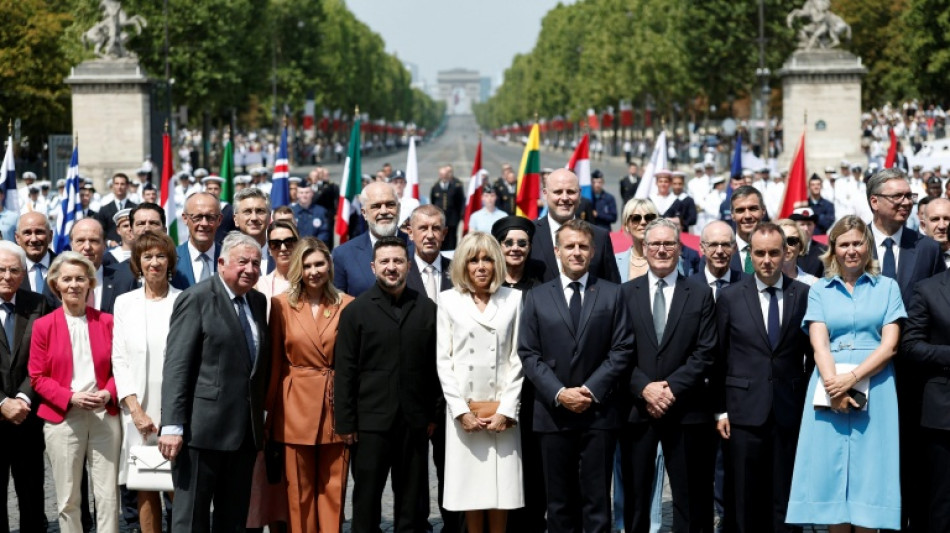
France flaunts firepower, unity with allies in huge parade / Photo: Benoit Tessier - POOL/AFP
France on Tuesday showcased military power and unity with European allies in its largest-ever national day parade, as European rearmament gathers pace in the face of Russia's invasion of Ukraine.
The final July 14 parade presided over by President Emmanuel Macron, the event brought together thousands of French troops, hundreds of European ones and two dozen foreign heads of state and government, including Ukrainian President Volodymyr Zelensky.
The parade, which marks the storming of the Bastille fortress in the French revolution and is by far the largest such event in any western European nation, was held a day after Macron hosted a new summit of Ukraine's allies, four-and-a-half years into the full-scale Russian invasion.
Other European leaders attending the parade included German Chancellor Friedrich Merz and, on one of his last foreign engagements, British Premier Keir Starmer, who has spearheaded with Macron European efforts to support Ukraine.
With nearly 6,700 troops, 98 aircraft, 31 helicopters and 315 vehicles, a record number of military personnel were marching the traditional route between the Arc de Triomphe and the Place de la Concorde in Paris.
- 'At the cost of blood' -
"What is marching past is a Europe united and determined to support Ukraine in the face of Russia -- a Europe confident in itself," deputy defence minister Alice Rufo told RTL radio.
Tens of thousands of members of the public braved a scorching heatwave to attend the celebrations, having obtained special QR codes to allow them to cross the security perimeter.
Around 500 soldiers from the so-called Coalition of the Willing of mainly European nations supporting Ukraine against Russia were marching. Symbolically, 25 Ukrainian soldiers followed the troops of coalition members.
Macron, who has pressed for a strategically autonomous Europe less dependent on the United States, on Monday said Europe would fight for freedom, even if it required its own troops shedding blood.
"Yes, we cherish freedom and the rule of law. And yes, we stand ready to fight to defend them. Always, and at the cost of blood if necessary."
- 'Strategic solidarity' -
With threats growing to European security and US President Donald Trump regarded as an unpredictable ally, Chief of the Defence Staff General Fabien Mandon described the parade on X as "a physical embodiment of the strategic solidarity between our countries".
Mandon caused a storm last year when he said France must be prepared to "accept losing its children" in a potential future conflict with Russia.
Ukrainian pilots trained in France co-piloted two French Mirage 2000s in a flyover, planes transferred to Ukraine to defend its airspace against Russian drones.
Zelensky hailed the Ukrainian presence as "a sign of respect and recognition of the strength of Ukraine, our people, and our armed forces".
Soldiers from the UK's Grenadier Guards marched alongside the French Garde Republicaine, in the biggest British contingent to join the parade in more than two decades.
For the first time, French aircraft flew over Champs-Elysees avenue carrying under their wings dummy weapons -- such as the Scalp cruise missile -- demonstrating an armed force that aims to be combat-ready.
Griffon and Jaguar armoured vehicles, along with drones mounted on transport trucks, showcased the modernisation of equipment in recent years.
This year's military parade is Macron's last as president before he steps down next year after a maximum two consecutive terms in office that have seen him seek to boost defence spending and ramp up cooperation with allies.
This year's parade is also being held 10 years after a truck driver on July 14, 2016, ploughed into crowds leaving a Bastille Day fireworks display in the southern city of Nice, killing 86 people and wounding more than 400.
Macron is due to head to Nice later in the day, while the Champs-Elysees is in the evening expected to fill with supporters for the France-Spain World Cup semi-final.
A.Goretti--IM