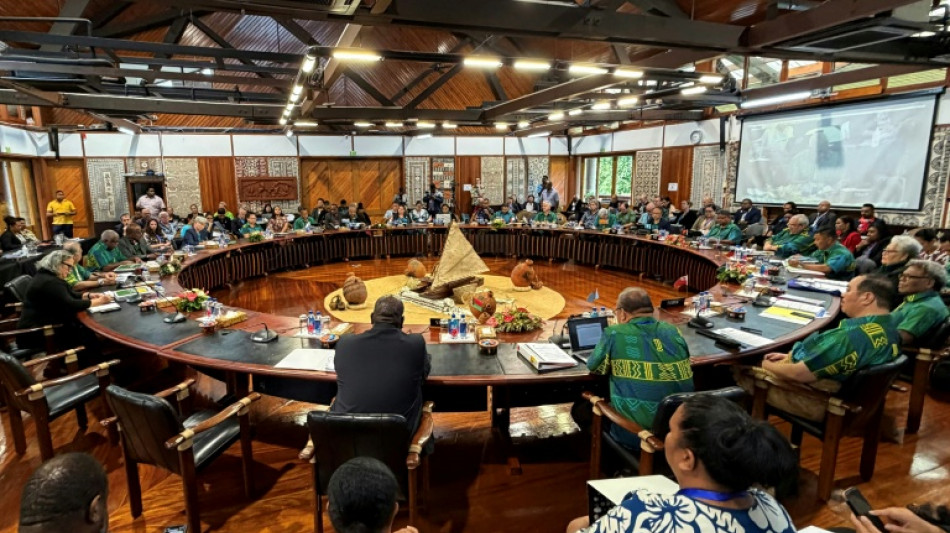
Pacific nations fail to agree on statement condemning China missile test / Photo: Ben STRANG - AFP
Pacific diplomats gathered in Fiji failed on Friday to agree on a joint statement condemning China's recent test of a nuclear-capable missile in the region, with New Zealand's foreign minister accusing them of appeasing "outsiders".
Beijing gave only a handful of nations short notice before test-firing an intercontinental ballistic missile last month, flexing its military might in a region where it has long sought to expand its reach.
The rocket appeared to land in a patch of ocean somewhere between Solomon Islands, Nauru and Tuvalu, monitors have said.
It sparked condemnation from multiple Pacific leaders, but the 18-member Pacific Islands Forum is yet to issue a formal response to the test.
New Zealand's outspoken Foreign Minister Winston Peters said following an hours-long meeting the group had failed to agree on a joint statement condemning the launch.
He did not name the two member states that had blocked the statement, but China-friendly nations Kiribati and Nauru are understood to have had little interest in formally criticising one of their major partners.
"They didn't actually lay out any reasons apart from their disagreement," Peters told journalists.
He accused them of appeasing "outside partners' wishes, rather than those that belong to the Pacific Islands Forum".
"We made it very clear that we do not think that outsiders should be telling the insiders -- that's us who have been here for thousands of years -- what our position should be," he added, a veiled swipe at China.
Tuvalu, a diplomatic ally of Taiwan, had also called for a joint statement and said it hadn't received notice in advance of the test.
"We don't want to be intimidated by any powers," Pasuna Tuaga, the country's Permanent Secretary of Foreign Affairs, Labour and Trade, said on the sidelines of the talks.
"That's not the way that we want to be treated," he said.
"That's why we want to send a very strong statement from the Pacific as an intercollective, because that would also strengthen our position."
Tuaga said the missile had landed "somewhere very close" to Tuvalu and that it had requested help from a number of powers -- including the United States and the Chinese -- in finding the dummy warhead.
- 'Outsiders meddling' -
Australia's Foreign Minister Penny Wong said before the meeting she hoped China took note of the "very clear response" already sent from the Pacific about the test.
"The majority of the Pacific Islands Forum did express concerns over China's ballistic missile test," she said.
Friday's meeting in Fiji's capital Suva comes ahead of a full leaders' meeting in Palau in September.
Palau -- an archipelago of hundreds of islands around 800 kilometres (497 miles) west of the Philippines -- is among the few nations to have diplomatic relations with Taiwan, the self-ruled democracy which Beijing claims as part of its territory.
Diplomats were also expected Friday to discuss which key partners should be allowed to attend that meeting.
Last year, the Solomon Islands banned all partner nations from attending the leaders' meeting in Honiara in response to China demanding Taiwan be excluded.
Peters, in response, accused "outsiders" of meddling in the summit.
P.Conti--IM