Sabbath cafe clash lays bare Israel faultlines / Photo: AHMAD GHARABLI - AFP
Alma Ronen has been fighting in the Israeli military nearly constantly for more than two years. Spending her Saturday not in uniform but in a T-shirt and jeans, she would like to enjoy a coffee outside -- and resents that her more religious compatriots think otherwise.
Every week since June, ultra-Orthodox protesters have descended on a cafe in central Jerusalem that lies precariously close to their neighbourhood, angered it has opened on the Sabbath, or Shabbat, the day of rest when observant Jews shun work, machinery and exchanging money.
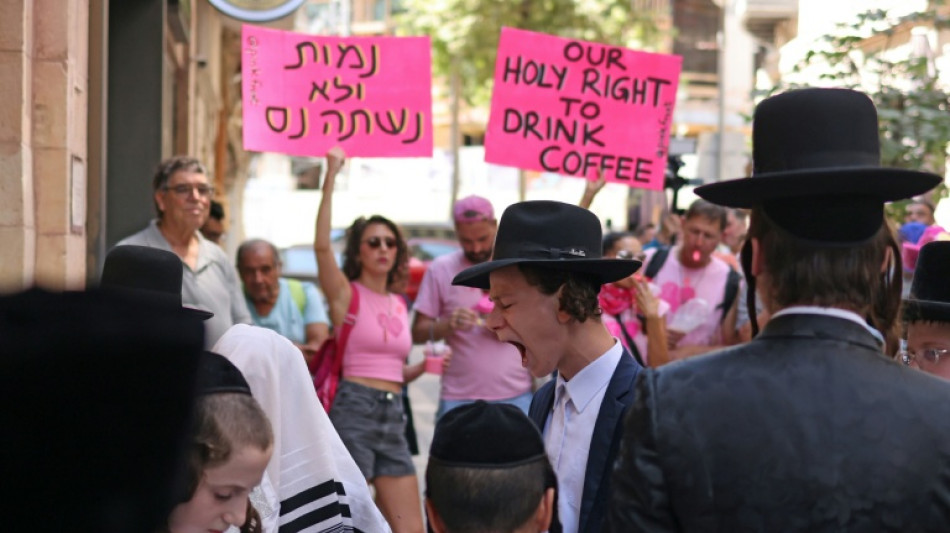
Clad in their matching modest black suits, dozens of ultra-Orthodox Jews -- all men and boys -- shouted "Shabbat!" as they approached Cafe Basimta, with several younger ones working themselves into a frenzy as they screamed and theatrically pretended to spit or throw down their hats.
Secular Israelis were prepared with a counter-protest, blowing whistles to drown out the chants and with some wearing pink lapel buttons showing a middle finger. One held up a banner, "Our Holy Right to Drink Coffee."
The face-to-face feud on the Jerusalem street presents a snapshot of two very different Israels as the country prepares for October 27 elections that will be a verdict on Prime Minister Benjamin Netanyahu.
Netanyahu, while personally secular, has relied politically on ultra-Orthodox Jews for nearly two decades. Now leading the most right-wing government in Israeli history, he has helped the ultra-Orthodox exert growing clout.
- Anger over military service -
In a source of particular bitterness for many secular Israelis, ultra-Orthodox Jews enjoy stipends for religious study and with Netanyahu's backing are exempt from military service, even as forces are stretched fighting a regional war since the October 7, 2023 attack by Hamas.
"I feel anger in my heart that only some people must go to the army and serve," said Ronen, 20, who has been fighting in Gaza and southern Lebanon.
"These people only have their lifestyle and are not open to any opinion but their own," she said.
Amit Yair, 77, was blunter as he waited in a long queue to order coffee.
"The Orthodox are parasites. You can't say any other word for this," he said.
"All they want is money from the government," he said. "They say it's God's land but they want to kill everything that is here to make it a Halachic state," or a government run by Jewish law.
The cafe was opened by a supporter of preaching Christianity to Jews, a movement derided by many Jews, although customers said the identity was irrelevant to them.
One Orthodox protester, engaged in a shouting match with a counter-demonstrator, said he had chosen to live in a religious area.
"I don't want my kids to leave the house and see a coffeeshop open," he said.
"It's not a matter of not respecting you, but this is attacking my family's faith," he said. "When you say you're a Jew, that means a commitment."
Ultra-Orthodox Jews approached at the protest declined to speak to journalists, saying that doing so would violate Shabbat.
- Society shifting in both directions -
Fifty-three percent of Jewish Israelis identify as completely or somewhat secular, according to a study last year by the Jewish People Policy Institute, although Israelis have turned increasingly to religion -- and further to the right -- since the trauma of October 7, the deadliest attack ever against Israel.
Shlomit Ravitsky Tur Paz, the head of the religion and state programme at the Israel Democracy Institute, said that Israeli society has progressively become more secular -- with more businesses and local public transportation open on Shabbat and growing acceptance of LGBTQ rights.
"At the same time, we see the exact opposite direction demographically" as religious Jews become a greater proportion of the population, she said.
She said that political criticism of the ultra-Orthodox has grown due to their role under Netanyahu, who attempted controversial judicial reforms and since October 7 has pursued war across the Middle East.
"The ultra-Orthodox sit in the government and they are part of the decision to keep the war going, but they're not paying the price with their children being drafted or the blood of their children," she said.
Netanyahu's main election challengers, led by former military chief Gadi Eisenkot, have made the draft a signature issue, vowing to end exemptions to military service.
Aya Lewkowicz, a member of the Pink Front activist movement who came from overwhelmingly secular Tel Aviv to help protect the Jerusalem cafe, said Israelis should choose for themselves how to observe Shabbat.
"Everyone should have the freedom to rest the way they want to rest and not have it be dictated by a small minority that gets backing from the government," she said.
After several hours of noisy confrontation, the Orthodox protesters left, with plans to fight their battle again next Saturday. And every week, as the cafe's struggle becomes known, the queue for coffee gets longer.
A.Goretti--IM