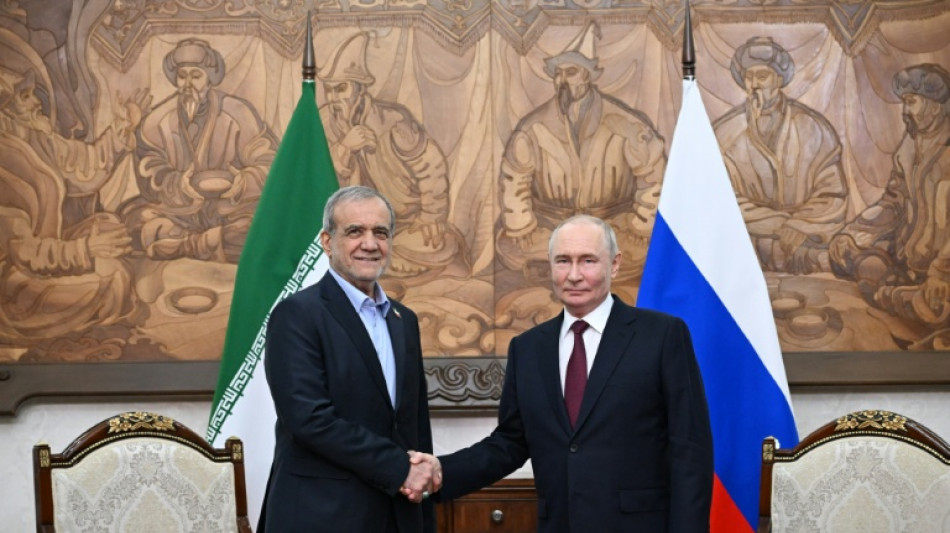
Iran president urges return to truce, hails Russian support / Photo: Kristina Solovyova - POOL/AFP
Iran's President Masoud Pezeshkian on Tuesday vowed to match any US move to return to a June deal aimed at ending their war, warning that diplomatic efforts could be endangered by "pressure and threats" from Washington.
He also thanked Russian leader Vladimir Putin for Moscow's stance on the conflict, in comments during an international summit in the Kyrgyz capital Bishkek.
Russia and Iran -- two of the most sanctioned countries in the world -- have massively deepened their military and trade ties during Moscow's invasion of Ukraine.
Putin and Pezeshkian held talks on the sidelines of the Shanghai Cooperation Organisation (SCO) summit, attended by over a dozen leaders including China's Xi Jinping and Indian Prime Minister Narendra Modi.
They met a day after US President Donald Trump -- who has warned Moscow and Beijing against arming Tehran -- threatened to hit Iran "hard" after it and the United States traded fire for the first time in weeks.
Pezeshkian told the summit that if the United States returns to the deal aimed at ending months of hostilities, Iran "will immediately take reciprocal action", according to the Iranian presidency's website.
The deal, meant to set the stage for final peace talks, has collapsed as both sides accused each other of violating its terms.
Pezeshkian warned Tuesday that a return by the United States to "a policy of pressure and threats could derail the path of diplomacy".
He later met Putin, telling him: "We appreciate and thank you for your positions at every stage."
He added: "This shows that our relationship is a strategic relationship; it is not an ordinary relationship."
- Putin hails Iran's 'courage' -
Putin said that Russia was "trying to provide you with the assistance you need".
"We admire your courage and resilience in the fight for your national interests," the Russian leader said, according to Russian media.
"Despite the military and political situation, we are maintaining the momentum of our trade and economic relations from last year," he added.
Russia and Iran are both under massive international sanctions and have become increasingly reliant on each other.
The US on Monday vowed to keep up a pressure campaign aimed at crippling Tehran's economy.
The Middle East war began in late February with the US and Israeli attacks on Iran that killed its former supreme leader Ayatollah Ali Khamenei.
Iran and the United States resumed exchanging fire on Monday following more than a month of relative calm, with the Strait of Hormuz a key flashpoint.
Tehran has maintained its closure of the strategic waterway, while saying it would return to its commitments under the June deal, which included reopening Hormuz, if the United States did the same.
- 'A multipolar world' -
The SCO summit takes place four-and-a-half years into Moscow's invasion of Ukraine and six months into the war between Washington and Tehran.
The Ukrainian conflict was not mentioned publicly at any point but Putin spoke for an hour and a half with his Turkish counterpart Recep Tayyip Erdogan, whose country has hosted several rounds of talks to put an end to the war, according to the Russian news agency Ria Novosti.
Xi said Russian-Chinese ties had become "more solid" and that their "prospects will be even brighter", while Putin said cooperation was "successfully developing on all fronts".
Russia's economy has become increasingly dependent on China since its full-scale invasion of Ukraine.
The SCO has historically focused on economic issues but has gained momentum in other fields in recent years under Moscow's and Beijing's leadership.
But he added: "It is clear that new multilateral regional structures... are organically integrating into the architecture of a multipolar world alongside the United Nations."
On top of its 10 members, the SCO now has 15 so-called "dialogue partners", including Turkey, Saudi Arabia and Qatar, and two observer countries: Afghanistan and Mongolia.
bk-burs/ach/rlp
L.Bernardi--IM