Scars of Marawi siege linger as Philippines poll nears / Photo: Ted ALJIBE - AFP
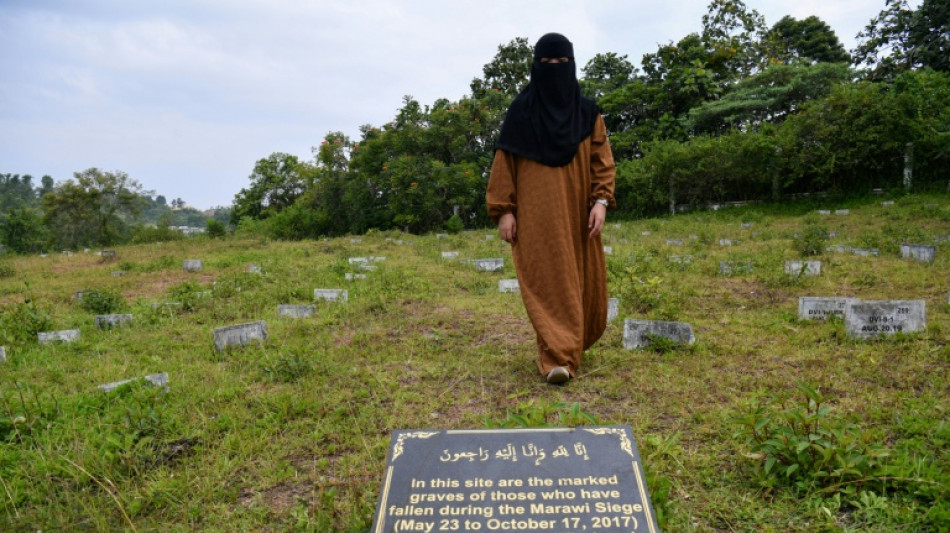
Near a resettlement site for survivors of the bloody 2017 siege of Marawi, a woman wearing a black face veil walks across a hilltop dotted by tombstones without names.
Sophia Aminolla, a nurse and mother of two, does not know if her missing younger brother Amerel is among those lying beneath the numbered graves. She is not alone.
As the now semi-autonomous Muslim region in the southern Philippines aims to turn a new page with its first elections on Monday, the gravesite is a painful reminder that the healing is far from complete.
"I don't know if he is still alive or not. But my instinct says he's alive, because he always comes home in my dreams," Aminolla told AFP during a visit to the site this week.
From May to October of 2017, the Philippine military and gunmen linked to the Islamic State group fought brutal house-to-house battles that turned Marawi's 400-hectare business district into a ghost town.
More than a thousand people were killed by official count, mostly civilians. The number of missing varies, with the International Committee of the Red Cross listing more than 300 individuals.
"What the siege destroyed is not only the physical structures, the dead, but the social fabric of our community," Drieza Lininding, chairman of local rights monitor Moro Consensus Group, told AFP at the gravesite, where as many as six bodies are contained in some plots.
The displaced, along with relatives of those killed, are eligible for compensation.
A special government board has been created to handle their claims, with about 6.5 billion pesos ($104 million) paid out so far, and at least half of the estimated 14,000 claimants still waiting.
But the board requires a death certificate issued by the government for "presumptive deaths", Marawi Compensation Board spokesman Johary Lumna said.
Aminolla, who now leads an advocacy group for the war missing, said her family's claim had been rejected.
A relative spotted her brother last at a hospital in a nearby town where he was taken after being injured by an explosion, she said.
He was never seen again.
- 'Ground zero' -
At Marawi's "ground zero", faint construction sounds can now be heard as a few of the darkened hulls of destroyed buildings are rebuilt with help from indemnities.
Teenage girls in headscarves zoom across the nearby lakefront on e-scooters as children play next to picnicking mothers.
Majul Gandamra, mayor during the Marawi battle, estimates around 10 percent of the city's 2017 population of about 200,000 have yet to return or be resettled, even as business now booms at the city's new commercial district.
Soraya Tambo, 73, has reopened her motorcycle parts shop on the ground floor of her four-storey property, aided by 500,000 pesos in building materials and some cash handed out by the regional government.
The empty upper floors still bear the scars of war she hopes to fix when her pending compensation claim comes through.
On one wall, colourful graffiti left behind by combatants from the IS-aligned Maute group reads: "End War!"
- Empty shelves -
Four kilometres (2.5 miles) away, displaced families at the temporary Sagonsongan resettlement site still live inside cramped 16 square-metre units they were supposed to have vacated in 2022.
Mother of six Annalyn Pangandaman, 47, said there is no tap water and the community endures intermittent power cuts. Her husband Jamil, 50, has struggled to land steady work.
"I'm a grocer, but my shelves are empty, zero. We have eaten everything," she told AFP.
Still traumatised by the fighting, her now 12-year-old daughter will cry and jump into their arms at "the mere sound of something falling on the floor", she added.
"Maybe the greatest injustice that these folks have faced since they lost their homes originally (is) their inability to return," Acram Latiph, executive director of the Institute for Peace and Development in Mindanao, told AFP.
With its mandate set to expire in 2028, time is running out for the compensation board to handle the thousands of cases still in process.
For others, like Aminolla, money will never be the answer.
"We're angry because we are not being given the right answers," she said of her missing brother.
"Why is the government still sleeping?"
T.Abato--IM