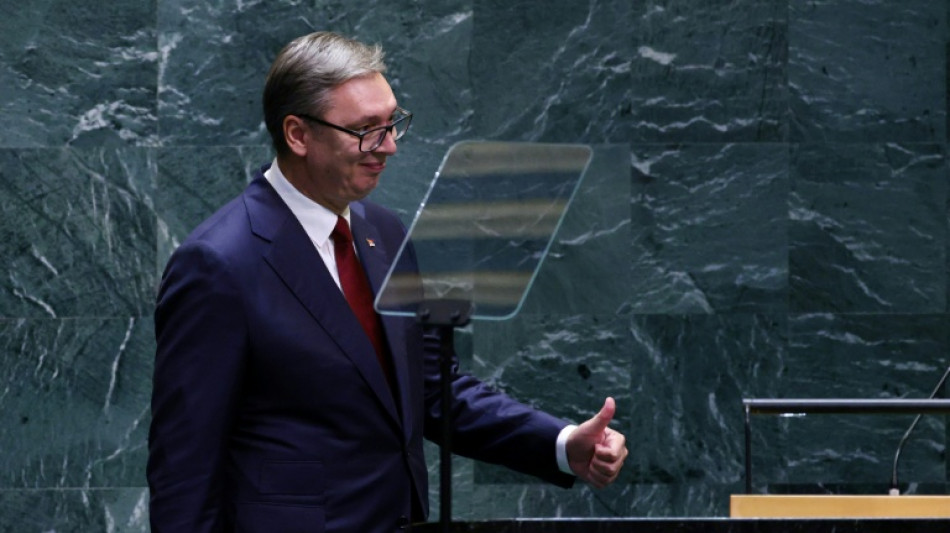
Aleksandar Vucic: from Milosevic minister to long-serving Serbian statesman / Photo: Leonardo MUNOZ - AFP
The dominant force in Serbian politics for over 14 years, Aleksandar Vucic climbed from the wreckage of strongman Slobodan Milosevic's cabinet to the centre of power using his brand of populist nationalism.
To his supporters, Vucic represents stability, development and patriotism in a country long overshadowed by the bloody wars of the 1990s and the international isolation that followed.
But his opponents see him as increasingly authoritarian, twisting between the Kremlin and Brussels, leading a government accused of endemic corruption.
Now his Serbian Progressive Party faces the biggest challenge since it came to power in 2012, as a years-long protest movement emerges, forming a new political force ahead of the October 25 snap poll.
"I served you faithfully. I served all of you, and our homeland Serbia, honourably and honestly throughout my presidential term," Vucic told supporters gathered outside the presidential palace shortly before submitting his resignation.
"The fight is only beginning," he told the crowd, which was chanting his name.
- Political turnaround -
Vucic rose to prominence in the 1990s as an ultra-nationalist ally of Milosevic, serving as his information minister in 1998.
After the Yugoslav strongman was ousted amid widespread protests in 2000, Vucic became a senior figure of the far-right Serbian Radical Party.
Throughout his time in the party, he was a vocal supporter of Bosnian Serb political and military leaders Radovan Karadzic and Ratko Mladic, both later sentenced to life for genocide and other crimes committed during the Bosnian war.
The party's leader Vojislav Seselj was also convicted of crimes against humanity.
But Vucic underwent a dramatic rebrand in 2008.
Ditching the Radicals, he co-founded the conservative, pro-European Serbian Progressive Party (SNS), which won parliamentary elections in 2012 and has dominated Serbian politics ever since.
He served as deputy prime minister, defence minister and prime minister before becoming president in 2017.
Even after polishing his image, Vucic has been reluctant to distance himself from nationalist leanings and far-right associates.
He has repeatedly stopped short of condemning Serbs convicted of atrocities during the 1990s conflicts. He looked the other way as pro-government media and political allies openly praised war criminals.
Despite trying to deny state involvement in a large funeral gathering for Mladic in the Serbian capital last month, several of his ministers attended, drawing sharp criticism from Brussels.
- 'Land of cranes' -
A relentless campaigner, he maintains a near-constant presence on pro-government television channels, embracing locals in tiny rural villages and chastising his critics during lengthy news conferences.
Over the years, Vucic has cultivated the image of a tireless leader criss-crossing Serbia, attracting investment and creating jobs.
At the same time, he has juggled the competing interests of European Union aspirations and Serbia's close ties to Russia.
Supporters also praise him as a brave defender of Serbian sovereignty, spending billions of euros on defence -- as he warns of foreign influence and pressure from NATO-member neighbours.
He most often cites Serbia's infrastructure and improved living standards as proof of his success, once pledging to make the country a "land of cranes".
From the gleaming waterfront district, with its glass tower rising over the city, to the numerous projects unfolding in preparation for Expo 2027, his party's slogan "Serbia is Winning" is plastered on billboards across the capital.
- Novi Sad -
But when a concrete canopy collapsed at Novi Sad's newly renovated train station in 2024, killing 16 people, accusations of corruption that had dogged many of his signature projects, including the waterfront, caused an outpouring of anger.
Student-led demonstrations calling for transparent investigations drew hundreds of thousands to the streets in the largest protests since the Milosevic era.
As demands grew into calls for snap elections, so did Vucic's and his supporters' pushback.
Students manning university blockades were labelled tools of foreign powers.
At the same time, party loyalists occupied a park outside the presidential palace, amid growing reports of anti-government protesters facing arrest, violence and intimidation.
"Students are winning! I think it is crucial that we unite around that narrative," student Dimitrije Potic told AFP at a May rally in Belgrade that drew more than 180,000 people.
Earlier in September, nearly two years into the protests, Vucic, finally called snap elections for October, citing "major turbulence on the domestic political scene" -- but meeting a key student demand.
B.Agosti--IM