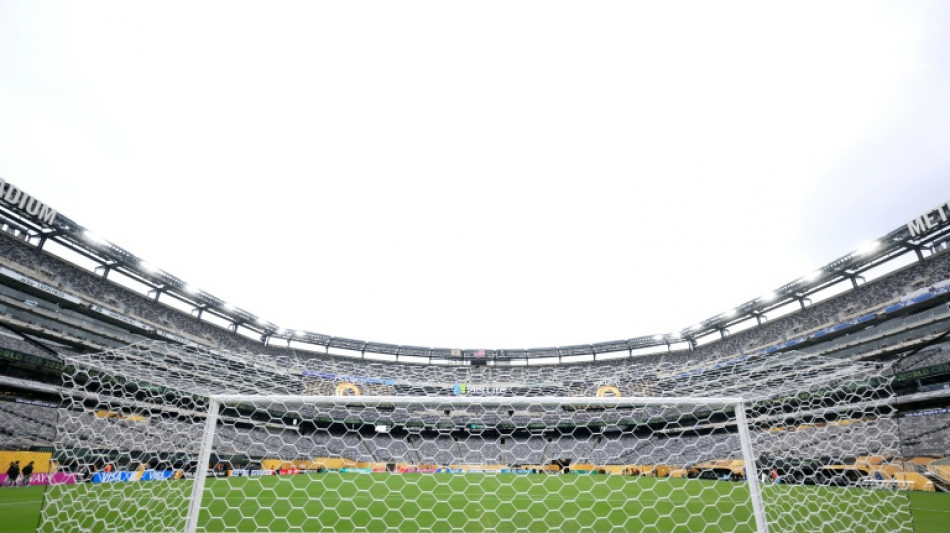
War, politics clouding World Cup on 100-day countdown / Photo: David Ramos - GETTY IMAGES NORTH AMERICA/AFP
Donald Trump's brutal immigration crackdown, polarized politics and a war unleashed on Iran have tarnished the global image of the United States just under 100 days before millions of fans are expected to visit for the World Cup.
This summer's unprecedented 48-team World Cup with 104 matches across the US, Canada and Mexico had been an alluring prospect, with FIFA boasting of unprecedented ticket sales and sold-out matches.
But the Republican president's actions since his return to power last year have complicated the picture, with plummeting tourism rates leaving the US hotel industry in sore need of the nearly seven million expected soccer fans.
Trump began a ferocious aerial assault on Iran Saturday, killing its supreme leader Ayatollah Ali Khamenei, and has warned it could continue for weeks.
The head of the Iranian Football Federation, Mehdi Taj, warned within hours that his nation could refuse to play in the tournament, saying "we cannot look forward to the World Cup with hope".
FIFA president Gianni Infantino's message Tuesday to mark 100 days to go until kickoff, avoided directly mentioning the war, saying only the World Cup "will have the world coming together, and this is probably the most important fact in this particular period of time".
As soon as he began his second term as president, Trump launched a tariff war against nearly the entire planet and in particular his nation's neighbors and World Cup co-hosts.
He has repeatedly threatened to make Canada the 51st American state and intervene militarily in Mexico if it does not tackle drug gangs.
And Washington has stoked tensions with its historic European allies, thanks to Trump's designs on Greenland, an autonomous territory of Denmark, and his vacillating support for Ukraine in its battle against invading Russian forces.
The Iran war looks set to exacerbate the strains with Europe -- Trump threatened Tuesday to "cut off all trade" with Spain after it refused to let US planes use its bases to launch attacks.
In addition, few Latin American or African countries have found favor with a White House that has severely restricted its immigration policies.
- 'Proper credentials' -
In mid-January, the US froze immigrant visas for 75 countries under its crackdown on illegal migration.
Among the targeted nations were four countries qualified for the World Cup: Iran, Haiti, Senegal and Ivory Coast.
The White House said this does not affect tourist visas, and therefore fans who have tickets, who can benefit from expedited visa appointments at US consulates.
But visas are not guaranteed for ticket holders, and many fans have expressed fears over how they will be treated upon arrival at US airports.
"As long as people are coming with the proper credentials, they're not having any issues," Delta Air Lines CEO Ed Bastian recently told AFP.
- 'Letting loose' -
Trump's anti-immigrant rhetoric and policies have sharpened divisions within the US.
The killing of two US citizens by Immigration and Customs Enforcement (ICE) agents during a large-scale operation in Minneapolis across December and January sparked widespread fury.
Fear that ICE agents could target legally compliant visitors based on their skin color or Hispanic accents has spread among World Cup fans, and could affect their willingness to attend the tournament.
"With this system, we risk not feeling like we're celebrating football," said Julien Adonis Kouadio, president of the official Ivorian supporters' committee.
"We must not impose too many restrictions that prevent people from letting loose," he told AFP.
For Haitian fans hoping to travel to the US, the situation is near impossible. The issuing of tourist visas for citizens of the Caribbean nation has been suspended since last June.
- Turmoil in Mexico -
Aside from the US turmoil, security concerns have spiked for fans planning to attend games in Mexico.
The recent death of the head of one of the country's most powerful and notorious drug lords in a military operation has triggered a wave of violence across several regions.
The fallout has particularly gripped Guadalajara, Mexico's second biggest city, which is hosting four matches.
A weekend of violence left at least 27 security force agents, 46 suspected cartel members and one civilian dead, with the city under quasi-lockdown as drug gangs rampaged.
Still, Infantino has said he is confident the matches will go ahead in Mexico, and the country's president Claudia Sheinbaum insists there is "no risk" to fans.
P.Rossi--IM