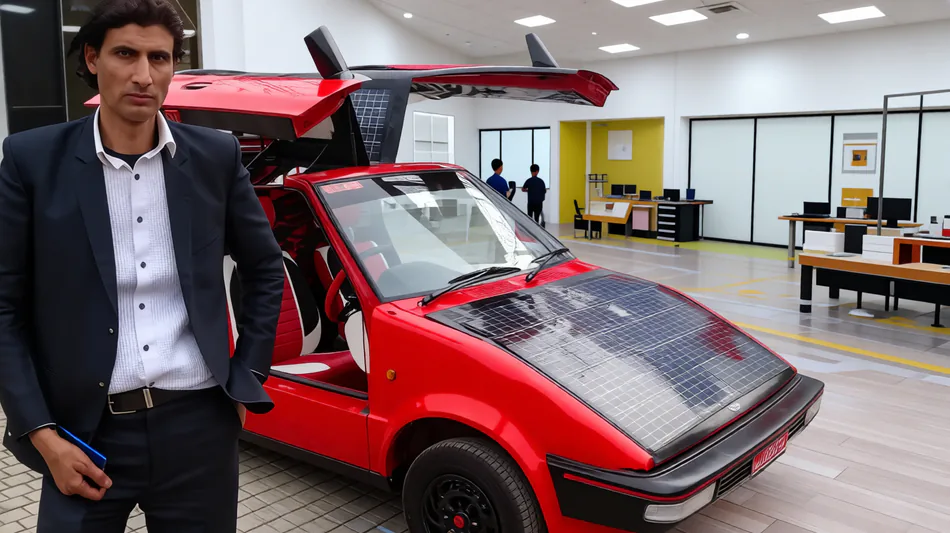
Kashmir Maths Teacher Builds Affordable Electric Vehicle in Backyard Workshop
Bilal Ahmad Mir, a mathematics teacher from Srinagar, Kashmir, has successfully developed a prototype hybrid vehicle designed to offer an affordable alternative to traditional cars. Working from his home workshop without institutional funding, Mir created 'SHE,' a three-wheeler that integrates solar energy, electric propulsion, and petrol backup to address local infrastructure limitations.
In a modest workshop on the outskirts of Srinagar, the capital of the Kashmir region, mathematics teacher Bilal Ahmad Mir is addressing a critical question in global automotive innovation: whether an electric vehicle can be made affordable without the backing of a billion-dollar corporation.
Mir’s journey began not in an engineering firm or a technology incubator, but from a newspaper article that warned of future fossil fuel shortages and rising energy prices. At the time, Mir was teaching at a local school in Kashmir, a region characterized by mountainous terrain rather than industrial manufacturing hubs. However, he recognized a pressing local need. Car ownership in the region has more than doubled over the past decade, surpassing 2.7 million vehicles, as public transport remains scarce and private mobility is essential for daily life.
Rather than waiting for market solutions to emerge, Mir decided to take matters into his own hands. He began exploring free energy sources, initially focusing on hydrogen and solar technologies. His first major attempt involved purchasing a used Nissan Micra with the intention of converting it into a hydrogen-fueled vehicle. However, due to limited resources and significant safety concerns, he was forced to abandon that specific project.
Undeterred, Mir shifted his focus to electric vehicles (EVs) and solar energy. He spent approximately three hours each day after his teaching duties researching solar technology journals and experimenting with designs. He funded the project entirely through his personal savings, treating it as a second job. This dedication eventually led him to establish BISA (Bilal’s Innovative Solar Automobile).
After a decade of experimentation, Mir unveiled his second attempt in 2022. Named 'Ray,' the vehicle was capable of generating approximately one kilowatt of power through integrated solar panels. The car drew significant public attention when Mir drove it through the streets of Srinagar. Residents stopped to observe the unusual vehicle, which bore a resemblance to the DeLorean from popular culture. Mir noted that he had not anticipated such positive public engagement with his innovation.
Despite the public interest, the project required a substantial financial commitment. Mir invested between ₹20 lakh and ₹22 lakh (approximately £15,000 to £17,000) of his own savings into the development. He noted that no financial assistance was provided by any organization during or after the completion of the car. Consequently, he had to source equipment internationally, often purchasing multiple items before finding components suitable for his specific design requirements.
The project gained international visibility in 2022 when images and videos of 'Ray' went viral online. This exposure led to an offer from industrialist Anand Mahindra, who proposed that engineers at Mahindra Research Valley collaborate with Mir to further develop the technology. While several major Indian companies acknowledged his work, the attention did not immediately translate into commercial sales, as 'Ray' remained a prototype.
Recognizing the limitations of relying solely on solar power—specifically the constraints of vehicle surface area and dependence on weather conditions—Mir began working on a production-ready version. He also considered the reality that EV charging infrastructure in Kashmir is still limited. To address these challenges, Mir partnered with fellow innovator Binish Gulzar.
Together, they developed 'SHE,' a compact three-wheeler designed to utilize three energy sources: solar power, electricity, and petrol. The concept aims to balance efficiency and reliability. Solar panels contribute to charging the battery, the electric system provides primary propulsion, and a petrol engine serves as a backup when solar generation is insufficient due to weather or lighting conditions.
The design also incorporates practical features for accessibility. The vehicle includes an electrically adjustable and detachable seat, intended to facilitate easier entry and exit for senior citizens and individuals with disabilities.
While the prototype has been tested on Kashmiri streets, Mir acknowledges that transitioning from a prototype to a mass-market product involves significant hurdles. These include manufacturing scalability, safety testing, regulatory certification, reliability assurance, battery performance optimization, maintenance logistics, and cost management.
Mir now aims to expand his market beyond Kashmir, with plans to eventually sell the three-wheeler globally. He has identified the United Kingdom as a potential target market due to its growing interest in electric and lower-emission transportation. He admits that a compact three-wheeler combining solar, battery, and petrol technologies occupies a unique niche in the current automotive landscape.
In the interim, Mir continues his work as a mathematics teacher, maintaining his hope that his affordable EV dream can eventually become a reality for a broader audience.
E.Accardi--IM