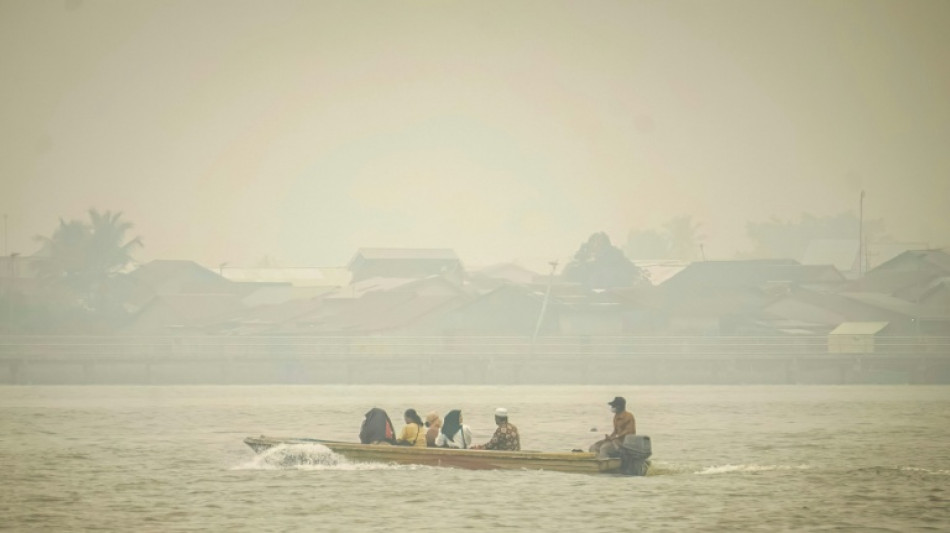
'Breathing toxin every day': Indonesians choked by haze feel helpless / Photo: DITO - AFP
Struggling to breathe through the acrid haze emanating from wildfires on Indonesia's Borneo island, residents told AFP on Wednesday they feared for their health but had little to do but wait out the foul-smelling hazard.
Indonesia, which shares Borneo with Malaysia and Brunei, is grappling with forest fires that have ravaged swathes of the island, partly caused by the El Nino climate phenomenon that has also affected other countries in Southeast Asia and beyond.
In Pontianak, the capital of West Kalimantan province, the thick, yellow smoke was so intense that it had paralysed the international airport over the weekend.
"My eyes sting, my head hurts. Over the past week it's been getting worse," resident Anggita Putri told AFP.
"While working, my chest feels tight, my head dizzy, my eyes burning. Even with this unhealthy air, we still must work," she said.
The air quality index for Pontianak briefly exceeded 1,100 over the weekend, Anggita said -- nearly four times the hazardous limit.
"I leave my child at home, so of course I have worries that go beyond just my own health. I'm also concerned about my child's condition," said the 28-year-old, who has a three-year-old son.
Another Pontianak resident, 35-year-old university lecturer Djunita Permata Indah, also said she was concerned for her two children, aged two and four.
"The situation is quite bad. I'm worried about the children's health. Even as an adult, I feel my head aching and dizzy because of the smoky air," she told AFP.
"But parents still must work, so the children are forced to keep going to daycare, where they remain exposed to the smoke that has already started to enter the house."
The health ministry said last week that more than 113,000 cases of upper respiratory tract infections had been recorded across seven provinces since the fires began to rage early this year.
Brief rainfall on Tuesday, which some residents had hoped could alleviate the risk, did little to help and only intensified the thick smoke, Djunita said.
- 'Surrounded by smoke' -
Local authorities said they were intensifying efforts to bring the haze under control, including by water bombing and cloud seeding.
Indonesia regularly battles wildfires during the dry season, which typically runs from July to October, but the blazes this year have been particularly bad in part because the powerful El Nino -- expected to be the strongest since comparable records began four decades ago.
Experts also blame climate change, decades of forest degradation and slash-and-burn land clearing practices that have changed the naturally fire-resistant landscape.
From Borneo, the haze has also spread to neighbouring Singapore and Malaysia.
The Indonesian government has said that between January and July, more than 202,000 hectares of land burned across the country.
The Nusantara Atlas project put that figure close to 300,000 for the same period, and last week estimated the total area affected, including August, was nearly 896,000 hectares.
For many residents on Borneo, the haze has not only affected their health but also disrupted their livelihood.
"My house is surrounded by smoke... For more than a month, I haven't opened the windows," said snack seller Desia, who like many Indonesians only has one name.
She told AFP she had stopped working two weeks ago because she could no longer spend much time outside.
"It's like we're breathing toxin every day," she said.
Desia's two children, aged 10 and 11, have not gone to school in over a month, spending most of their time in the only room in the house that has an air purifier.
"Right now, I just hope for rain," she said. "I've stopped hoping for anything from the government."
D.Lombardi--IM