Magyar's blitz against Orban's Hungary 'mafia' gathers pace / Photo: Attila KISBENEDEK - AFP
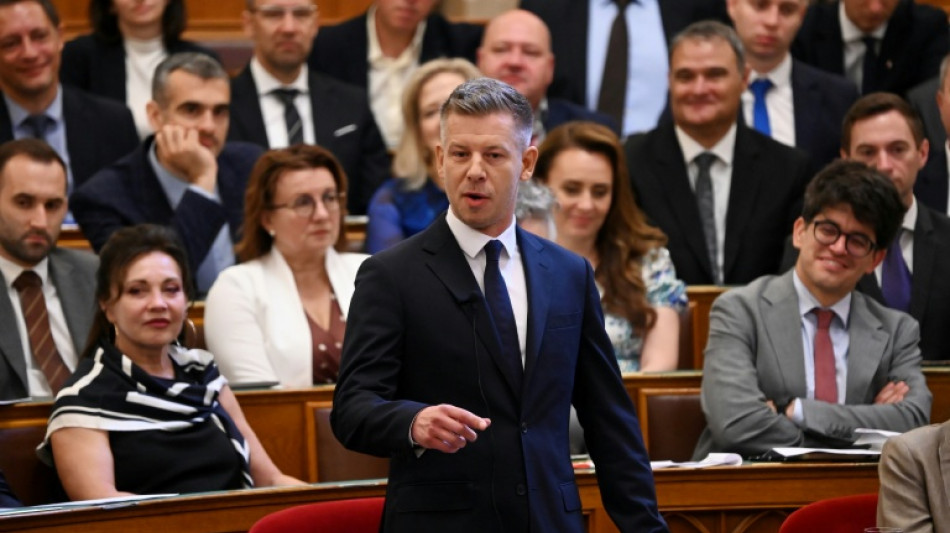
Hungary's lawmakers face a busy summer as Prime Minister Peter Magyar rushes to dismantle the political system built to cement Viktor Orban's hardline 16-year rule.
But some political experts and rights groups have criticised the speed and scale of Magyar's moves to demolish the institutions guarding Orban's self-styled "illiberal" democracy that won praise from US President Donald Trump and French far-right leader Marine Le Pen.
Since taking office two months ago on May 9 after toppling the longtime nationalist leader in an election landslide, Magyar has unleashed a blitz of measures aimed at rooting out Orban's "mafia" from the Hungarian state.
Besides proving popular with the public, the pro-European conservative's push to move on from the Orban era's fractious relationship with Brussels is key to rapidly unlocking 16 billion euros ($18.3 billion) in EU funds frozen over rule-of-law concerns.
Magyar's Tisza party commands a comfortable two-thirds majority in parliament and has voted in recent weeks to adopt a sweeping anti-corruption package and dismantle the so-called Sovereignty Protection Office that targeted government critics.
It has also approved a dramatic overhaul of public media, which under Orban had become a de facto mouthpiece for his Fidesz party.
Two public broadcasters had their news bulletins taken off air on Tuesday, with Magyar hailing "the end of propaganda broadcasts on public media platforms".
"These clearly signal the end of Orban's brand of intimidation and propaganda-based politics," Zsuzsanna Vegh, a political analyst at the US German Marshall Fund think tank, told AFP.
- 'Operation Purifying Fire' -
Some of Magyar's methods have provoked fierce debate.
Last month, the 45-year-old announced "Operation Purifying Fire", which includes another rewrite of the constitution aimed at preventing the Orban era's concentration of power ever happening again.
Before the promised wholesale constitutional change -- to be adopted after a lengthy public consultation -- parliament is to vote on a 12-point amendment which would remove Orban ally Tamas Sulyok as president.
Orban's Fidesz party has denounced the move as an attempt to establish "autocratic rule" -- a charge often levelled against the former nationalist leader during his tenure.
But it has also worried human rights and political experts, with Amnesty International calling the push to remove Sulyok "not acceptable".
Political scientist Gabor Torok has argued that the frequent constitutional tinkering sets a dangerous precedent, prompting Magyar to reply that it would "not be appropriate to go against the democratic will of the people".
Marta Pardavi, co-head of the Hungarian Helsinki Committee watchdog, argued that some of the proposed changes were indeed urgently needed.
"It is not just a matter of replacing specific individuals; the institutions themselves must also be strengthened," she told AFP.
But she questioned the rush to adopt other measures, pointing to a planned 12-year term limit on lawmakers. The provision would prevent prominent opposition politicians from running for re-election in 2030.
- A new era? -
Despite the radical overhaul, Magyar's policies are not too different from Orban's on some matters.
While Magyar has worked to repair ties with the European Union, he has maintained his predecessor's fervent opposition to its common migration policy.
His record on LGBTQ rights is likewise mixed.
The annual Budapest Pride march, which the police banned last year under Orban, was permitted to go ahead, attracting huge crowds.
But Tisza has yet to repeal any anti-LGBTQ legislation, including a 2021 law that the EU's top tribunal, the European Court of Justice, ruled in April violated "the very identity" of the bloc.
Magyar has however had success in curbing the dominance of the Fidesz-aligned media empire, which has been left reeling after his landslide victory.
Several private outlets owned by businessmen linked to the party have ceased publication or faced restructuring or layoffs in recent weeks as the state advertising revenues that sustained them under Orban have dried up.
"Now the oligarchs are unwilling to invest the 'spoils' -- the money they gained in public tenders -- because Orban has been weakened to such an extent that no one expects his return to power," Gabor Polyak of the Mertek Media Monitor told AFP.
H.Gallo--IM